24 April 2007

"Why Do You Live in Louisiana?"

Between 13 and 15 April 2007, I was visiting the Pacific Southwest District of the Unitarian Universalist Association. I was there to co-facilitate a facilitators training workshop for the Our Whole Lives Grades 7-9 and 10-12 comprehensive sexuality education curriculum jointly developed by the Unitarian Universalist Association and the United Church of Christ.

During the weekend, I would related experiences with sexuality education, bisexual - gay - lesbian - transgender rights, and the local "Bible Belt" culture from my time in Northwest Louisiana and the Southwest District of the Unitarian Universalist Association. These experiences would cause participants to ask me "Why do you live there?"

I think I found the answer in Monday's Shreveport, Louisiana daily newspaper. I can guarantee that the following letter to the editor would never be found in the Los Angeles Times:


Outlawing this sport (cockfighting) will put a lot of people of out jobs and hurt the economy of all Louisiana. They don't think of the people that will be put out of work. The feed stores will lose about one-third of their sales, that is a lot of business. Grain the farmers grow to feed these birds will not be bought by the feed stores, hurting the farmers. Hotels, gas stations and restaurants these people patronize will no longer get this business. Towns these fights are held in have come to depend on the out-of-town people to help them survive. At times, there are a thousand people coming into these towns for four to five days to stay and spend money. Some people raise chickens to sell to others, taking away their livelihood. These chickens have to have medicine and be wormed each month; this will hurt the veterinarian.

When you think outlawing cockfighting will help, think of the people you know it will hurt. Then decide what is more important — people losing their jobs and livelihoods, towns losing business they need to help survive, making outlaws out of honest people, or giving in to these animal rights groups that will leave Louisiana when they get what they want, but your fellow Louisianans will still be here without the way of life we love and without the revenue the sport generates.

In a sportsman magazine, the Humane Society said cormorants should be left on the endangered list and not be punished for what they do naturally, which is eating fish. Why can't a game rooster do what he does naturally, which is fight?

Tony Pickard
Sarepta LA

And opinions like this are what makes our region so unique and special. According to Wikipedia, cockfighting is illegal in all 50 states and the District of Columbia with the singular exception of Louisiana.

As Unitarian Universalists and religious liberals, we will never run out of social justice work in my state. There's always something that needs fixing.

18 April 2007

Two Computer Articles For Churches And Other Small-Budget Non-Profit Organizations

I found two articles today that may be useful for churches and other small-budget non-profit organizations:

How To Revive An Old PC With Linux

The article is described as a "short guide to getting your old clunker up and running again with a free Linux download and a reasonably quick installation."

The second article deals with computer security and personal computer firewalls:

How To Secure Desktop PCs With Personal Firewalls

This article may be useful for your church staff persons who travel and use wireless networks away from the secure network that one controls in your church.

08 April 2007

Exploring Digital Audio Recording at My Church

I've had the good fortune of having both an old computer that was gathering dust in our choir loft and ready access to "open source" audio recording and editing software at my congregation.

I've been experimenting with adding digital audio recording at All Souls Unitarian Universalist Church in Shreveport, Louisiana. This is yet another way to allow members, friends, and potential members to participate in congregational life and learn more about Unitarian Universalism. It's also something that our minister wants to start doing.

Digital recording allows our members who want a recording of the worship service to have it on audio CD. Audio CDs are useful for members who want a worship recording but don't have a cassette player in the car. The digital recording will also let us put digital audio files on the congregation's web site.

The old computer that I've plugged into our sanctuary sound board is a generic Windows PC-compatible clone that was formerly used by our office administrator until June 2006. It had an AMD Athlon 1200 MHz CPU, 768 megabytes RAM, 40 gigabyte hard drive, and a CD/RW drive. This older computer was purchased at least 4 to 5 years ago and had been upgraded from Windows ME to Windows XP Professional during its time as the office administrator's computer.

Since we don't have wired internet access in our sanctuary, I've installed a D-Link WDA-1320 PCI 802.11 b/g wireless LAN card on this computer. This allows me to access the internet using our church's wireless router (e.g. installing the latest software patches and security updates, uploading files to our congregation's web site, etc without having to drag the computer to a 10/100-Base-T internet connection in the church office). The reason for choosing this type of wireless LAN card is past experience using this card with Ubuntu Linux. It works "out of the box" without any special trick for the "Dapper Drake" and "Edgy Eft" releases).

To get the best performance out of this older computer, I installed Ubuntu 6.06 "Dapper Drake" on this computer instead of the Windows XP operating system. After installing the basic "Dapper" install and the latest security updates, I used the "Unofficial Ubuntu 6.06 (Dapper Drake) Starter Guide" to assist me in finishing the setup. The starter guide provides step-by-step instructions for installing "Automatrix2" on our computer. Automatrix2 automates most of the multi-media setup required for setting a computer that can read and write mp3 podcast files.

Ubuntu records the audio files in the "ogg" open-standard format. To edit these files (e.g. cutting out dead air time) and to convert the digital audio file into mp3 format used by nearly every portable audio player, I installed "Audacity," an open-source audio editor for Windows, Macintosh, and Linux.

Now that I've confirmed that all the hardware and software works during today's worship, I need to create some user documentation for the volunteers who run our worship audio system so they know how to record digital audio, edit for length if needed, and burn the digital audio to CD.

I will need to find some time to do that between the Our Whole Lives trainings I'm co-leading between now and June 2007.

There will be more to follow on this documentation in a future blog article.

Who Speaks for Unitarian Universalism on the Web?

In a blog article about the Unitarian Universalist Association's web site text describing the role of Christianity in modern-day Unitarian Universalism, UU blogger and minister Scott Wells raises the following questions:
"But today, with increasingly decentralized Internet communication and the name recognition this brings, editorial control for Unitarian Universalism is now much wider than the UUA staff and a few independent (but low circulation) periodicals. The emerging 'how long' question is 'how long will it be before an outsider won't necessarily go to UUA.org first?'"
Based on the search results on Google for Unitarian Universalism, this may already be happening.

The first search result listed isn't the "official" Unitarian Universalist Association's web site (which if you haven't noticed, has undergone a major redesign).

The first search result reported is the Wikipedia article on Unitarian Universalism. For comparison's sake, the first Google search result reported for Unitarian and Universalist are the "official" UUA web site.

For those Unitarian Universalists who are "polity wonks" (my adaptation of "policy wonk" to describe those who are concerned with congregational and association governance issues), who speaks for Unitarian Universalism on the web is an important question.

The Unitarian Universalist Association is the member congregations and the paid and volunteer staff should be responsive to the desires of the member congregations. The collective authorship of Wikipedia may be responsive to the Wikipedia readership but it may not be responsive to UUA member congregations.

This doesn't mean that Wikipedia is less accurate than the UUA web site. Wikipedia will probably cover some controversies that the UUA would not prominently cover on their web site (e.g. the "language of reverence" and "borrowing from other religions" debates). And the "group editing" process may more accurately reflect reality (even if this isn't the "corporate message" that our congregations want to present to the world). The Wikipedia article on us is pretty accurate.

For example, the UUA web site does mention the "hot-button" polyamory topic (based on a Google search of www.uua.org). Some of the search results are still active pages and some are not active after the web site redesign.

However, the UUA web site does not list Unitarian Universalists for Polyamory Awareness as an official UUA affiliate organization. However, Wikipedia does list it as an official independent affiliate. I'm sure that this doesn't sit well with persons who disapprove of this perceived connection between polyamory and Unitarian Universalism.

My concern with the trend towards decentralized communication is a lack of accountability. Who would our future decentralized internet voices for Unitarian Unversalism be accountable to? The loudest voice speaking about Unitarian Universalism on the internet may not reflect the desires of our congregations through an open and democratic process but rather something else entirely different.

27 March 2007

Viewing Anti-Christian Anger Through an Anti-Oppression Lens -- Greta Christina's Defense of the "Blasphemy Challenge"

Greta Christina is a San Francisco area writer who blogs about sexuality, atheism, politics and many other subjects.

She has written a defense of the "Blasphemy Challenge" on her blog after she took the challenge herself.

Part of her defense mentions the anger in the Blasphemy Challenge video clips. Greta touches on anti-oppression issues surrounding the unearned power and privilege that Christianity has in our society:
"And you know what? I'm proud and happy to stand up with the angry, pissy, juvenile ones, too. I see them, and my heart just breaks. I know that when you hear someone say something like "The Holy Spirit rapes children," what you hear is a terrible thing being said about your faith. But what I hear (although to be fair, I haven't seen that particular video and am just going on your description of it) is someone who, I'm betting, had an appalling religious upbringing, one in which they were taught cruel, traumatic, bigoted, and flat-out untrue things, and told that to even question them would send them to be burned and tortured in Hell… and who's only now coming to realize just how fucked up that was, and just how full of rage they are about it. (Or if they didn't go through that themselves, they know and love someone who did.) You see the insult -- I see the anger, the frustration, the trauma, the feeling of helplessness. And while I wish those people would express their rage in a better way than namecalling and insults, and while I hope they can move on from that eventually, my heart goes out to them. I get that this is where they need to be right now, and I want to stand with them and tell them that they're not alone.

Now, maybe that's not fair. Maybe it's not fair to be sympathetic with atheists who are angry about religion, and yet expect religious believers to get over their anger about atheists. But I feel the same way about women's anger towards men versus men's anger towards women; queer folks' anger towards straight people versus straight peoples' anger towards queers. The difference is in which group has the power. And in this case, it's not atheists."
This is very close to an article on my blog from March 2005 titled "Christian and Non-Christian Unitarian Universalists -- Anti-Oppression Implications."

I wrote about the negative attitudes expressed towards Unitarian Universalist (UU) Christians who belong to predominantly non-Christian UU congregations:
"UU [Unitarian Universalist] Christians need to remember that they are walking in the door of a church wearing a garment of 'power and privilege' that was not freely accepted but rather forced on them by our wider North American culture. UU Christians joining a predominantly non-Christian UU congregation are (unknowingly?) engaging in anti-oppression work by giving up unearned power and privilege granted to them by the wider culture. This is the theological equivalent of an adult advisor working with youth where the advisor gives up some of the unearned privilege that comes with being an adult."
Using this anti-oppression perspective allows us to understand why some Unitarian Universalists are strongly critical of Jesus, the Bible, and God but seem to be OK with non-Christian religious expression in their UU congregations.

26 March 2007

Asking Senators to Co-sponsor the REAL Act

Today, youth and young adult members of Unitarian Universalist churches, United Church of Christ churches, and other religious liberal groups were lobbying congress today in support of the REAL Act (Responsible Education about Life Act -- S. 368). The UUA and UCC were also sponsoring a REAL Act call-in day for lobbying our Senators for folks around the country to participate in this lobbying by phone.

The REAL Act would give states and communities the option to freely choose between abstinence-only sexuality education and comprehensive sexuality education by providing funding for both options.

After calling my Senators, I visited the Advocates for Youth web site. Here's my modified version of the sample letter provided on the Advocates for Youth web site that I sent to my Senators:
I am writing to ask you to cosponsor the REAL Act (Responsible Education about Life Act -- S. 368).

This legislation, introduced by Representative Barbara Lee (D-CA) and Senator Frank Lautenberg (D-NJ), would provide federal support for comprehensive sex education programs.

The United States has the highest rate of unintended teen pregnancies among all industrialized nations and American teens acquire an estimated 9.1 million sexually transmitted diseases a year. An average of two young people in the U.S. are infected with HIV every hour of every day.

Clearly, young people's health and lives are at risk, yet the federal government has spent over $1.4 billion over the past 10 years on abstinence-only programs that censor information about the health benefits of contraceptives and condoms.

Research indicates that teenagers who receive information about both abstinence and contraception are more likely to delay sexual activity and to have fewer partners and use condoms and contraception when they do become sexually active.

The most trusted medical and scientific institutions in our nation, such as the American Medical Association, the Society for Adolescent Medicine, the American College of Obstetricians and Gynecologists, and the American Public Health Association, all recommend comprehensive sex education as well.

For the past 10 years, the federal government has invested money into abstinence-only programs, which do not give teens the resources they need.

It's time for a change.

The REAL Act authorizes much-needed funding for programs that give teens the information and skills they need to make responsible decisions.

As a religious person who is active in my church and a parent of two teens, I'm outraged with our government's immoral and ineffective abstinence-only funding policies that fail to protect the health of young people. The abstinence-only programs are based in flawed ideology -- not reality -- and do harm our young people.

I urge you to become a cosponsor of the REAL Act.

Asking Senators and Representatives to Co-sponsor Access to Legal Pharmaceuticals Act

Today, I sent a letter from the Advocates for Youth web page to my Senators and my Congressman asking them to co-sponsor the Access to Legal Pharmaceuticals Act (H.R. 1652 / S. 809). Here's my modification to the pre-written Advocates for Youth letter:
I am outraged that young women across America are being denied safe and legal pharmaceutical products based on the ideological views of a few. Pharmacists have a responsibility to provide medications without judgment or fear.

The Access to Legal Pharmaceuticals Act (H.R. 1652 / S. 809) is designed to preserve the right to safe, legal, pharmaceuticals prescribed by a medical professional.

Decisions about whether to use safe and legal birth control should be made by a woman and her doctor, without restrictions by pharmacists.

98% of women use birth control at some point in their childbearing years and experts predict that access to emergency contraceptives alone could prevent as many as fifty percent of the 841,000 unplanned teen pregnancies every year.

However, because of barriers, only thirty seven percent of young women seeking contraceptive services ever receive them.

Young women are uniquely affected when a pharmacist refuses to fill a prescription because, as they may have limited access to transportation and funds, they can't afford to track down a pharmacist who will.

These young women, who are making the responsible decision to access birth control methods, should not be faced with a hassle or a judgment at the pharmacy. Pharmacists have a right to their personal beliefs about dispensing birth control, but cannot be allowed to impose those beliefs on women.

As a father of a teen daughter who is attending college and as a religious churchgoing person, I'm outraged that my daughter's reproductive freedoms could be harmed through a pharmacist who refuses to perform his or her professional duties.

I urge you to support the Access to Legal Pharmaceuticals Act and protect the right of responsible young women to receive safe, legally prescribed pharmaceuticals.

A Radically Nonsensical Literal Reading of Leviticus 18:22

Here is a radically literal but tongue-in-cheek interpretation of Leviticus 18:22 that popped into my head this afternoon.

This verse is often cited as a scriptural condemnation of homosexuality.

However -- when one reads the text literally, it doesn't prohibit all male-male sexual intercourse.

Here's the verse as translated in the Revised Standard Version:

"You shall not lie with a male as with a woman; it is an abomination."

The literal text only addresses male-male intercourse when the participants are prone.

It doesn't ban anal sex when both men are standing nor does it ban oral sex when one man is standing and the other man is kneeling. And -- for the incredibly gymnastic -- it doesn't ban the standing "69" position either. And it certainly doesn't ban mutual masturbation as long as the two men are not prone.

I suppose we can now legalize same-sex marriage as long as we require the use of twin beds by male-male couples. We would also need to ban double beds, queen-sized beds, king-sized beds, etc for male-male couples as well.

I'm pretty sure that bunk beds would be OK.

And male-male sex in hot tubs (which involves "floating" instead of "lying") would be acceptable within this Leviticus 18:22 framework.

This example shows the absurdity of trying to read the Bible as a literal sex manual in modern times.

The Bible (like many other ancient scriptures) works best when viewed holistic sense that provides us example of how to live ethically with each other.

24 February 2007

"What about those who have never heard about Christ? Is is fair they be 'damned' just because they were never exposed to Christianity?"

If you find these questions seem to be odd from a Unitarian Universalist perspective, then you're probably wondering why I've used them for the title of this blog article.

These questions are the topic for next Wednesday's meeting for my congregation's Unitarian Universalist Christian Fellowship Bible Study Group (this group is one of our congregation's "covenant groups"). Our local UUCF group is hosting a multi-week forum on "Questions and Concerns About Christianity" and these two questions will be discussed next week.

I'm surprised to know that these questions are current concerns for modern-day Unitarian Universalist Christians because I thought they were discussed in-depth during the 1800s and we have moved on to other aspects of Christianity in the Unitarian Universalist tradition.

Our Unitarian, Universalist, and Unitarian Universalist heritage is rooted in the Protestant Chirstian tradition and our tradition has looked at these questions in depth.

The early 1800s Unitarian view was one of "salvation by character." Rev. Jane Rzepka (Senior Minister, Church of the Larger Fellowship) describes "salvation by character" using the following words in her 2003 General Assembly CLF Worship Service:
"We are Unitarian Universalists, and our salvation comes not in the rapture but, historically at least, in 'salvation by character.' We believe there is something wonderful inside us -- you could call it inherent dignity and worth -- that allows us to work toward good character, wholeness, healing, and all that is good. We have within us a little core of natural hope -- Thoreau's bug in the sixty year old table metaphor could work here [refers to reading] -- some little bit of hopeful life that lies waiting to spring into action. And even better, most UUs don't just sit for sixty years waiting, we act to realize that hope, that life, that wholeness. In spite of the difficulties in our own experience and of life in the larger world, we do what we can. Therein lies our Unitarian Universalist salvation."
The early 1800s Universalist view was one of "salvation irrespective of character." That is best described using the words of Hosea Ballou in the address he gave to the 1851 Universalist General Convention in Boston (as recorded in his online biography page):
"In homely language, he summed up his belief in a God who, as a Father, loves all his children: 'Your child has fallen into the mire, and its body and its garments are defiled. You cleanse it, and array it in clean robes. The query is, Do you love your child because you have washed it? Or, Did you wash it because you loved it?"
A recent summary of the origins of modern-day Unitarian Universalist soteriology (theology of salvation) can be found in "Unitarian Universalist Identity" curriculum for young adults by Katie Tweedie Erslev:
UU Soteriology: Raising the Roof
"Once again, in contrast to the predominant foundation of the theology of Calvinism, our roof was raised by the 19th century Universalists. Universalism gave us a roof that saved us all. They said that what saves us is the power of creative love made viable to us in the person of Jesus.

Do we need to be saved from Hell? The Universalists said that we create heaven and hell on earth. We need to be saved from the Hells that we create."
So ... I guess that many Unitarian Universalists would view Jesus, his teachings, and the example he set during his pre-Easter life on Earth as one example of creative love saving others.

But I don't think that we would say that Jesus is the only example of creative love saving others.

These questions may be important for Christian newcomers to our congregation who are dealing with concerns about competing claims over Christian exclusiveness and religious pluralism.

But while this theology is an important part of our heritage that we should celebrate, it's not an urgent theological concern for most Unitarian Universalists today.

If one doesn't believe in Hell other than the hells we create in the here-and-now, is there any point in talking about it or wondering if those who have not heard about Christ are possibly condemned to hellfire and damnation?

And that's why I would find the discussion questions for this group's next meeting to be odd from my Unitarian Universalist perspective.

18 February 2007

Altruism, the "Open Source" Economy, and Churches

In a recent column in Time Magazine ("Getting Rich off Those Who Work for Free"), Justin Fox discusses non-monetary motivations in the marketplace. Here's a quote from the column:
It might seem very odd to look to a long-dead Russian anarchist for business advice. But Peter Kropotkin's big idea -- that there are important human motivations beyond what he called "reckless individualism" -- is very relevant these days. That's because one of the most interesting questions in business has become how much work people will do for free.

Kropotkin was an aristocrat who, after being imprisoned for his insurrectionist activities, escaped and fled to England in 1876. He also drew the first good topographic maps of Siberia and wrote a memoir of his revolutionary days that has become a minor classic. More to the point, he proposed in his 1902 book, Mutual Aid: A Factor of Evolution, that the survival of animal species and much of human progress depended on the tendency to help others.

That I even know of Kropotkin comes courtesy of the Wikipedia entry for the "gift economy," the current term of art for this altruistic approach. Wikipedia is, of course, a prime example of the gift economy at work. Argue about its inaccuracies all you want, but the volunteer-authored online encyclopedia is on its way to becoming (if it isn't already) the world's dominant reference resource.

Open-source, volunteer-created computer software like the Linux operating system and the Firefox Web browser have also established themselves as significant and lasting economic realities. That's not true yet in the worlds of science, news and entertainment: we're still figuring out what the role of volunteers will be, but that it will be much bigger than in the past seems obvious.
Many will point out that Unitarian Universalist churches have operated as mostly volunteer-run operations with limited paid staff contributions. And many of our small lay-led fellowships are totally volunteer-run organizations. However, church volunteer may limit their cooperative sharing to internal congregational work and not result in forming cooperative sharing networks with other congregations.

For Unitarian Universalists, we have some resources for sharing our resources with other congregations and learning from the experience of others:
Using these online resource would move Unitarian Universalism towards a cooperative "open source" sharing model where hard-earned experiences in a local congregation can benefit all.

17 February 2007

Best Explanation of Recent Anglican Primate Meeting

The best explanation of the recent events in the Anglican Communion at their Primates Meeting in Dar es Salaam, Tanzania can be found online here:

The Primates Meeting

This is the work of the British cartoonist Dave Walker. His work includes the cartoon summary of the Windsor Report and other church-related humor.

29 December 2006

Resources on History of Congregational Polity Within Unitarian Universalism

In a recent post, Paul Wilczynski mentioned the Cambridge Platform. The Cambridge Platform is an important historical document for the Unitarian part of our heritage. It is the foundation of our congregational polity.

Congregational polity is a subset of a larger topic -- ecclesiastical polity. Wikipedia defines "ecclesiastical polity" as:
" ... the operational and governance structure of a church or Christian denomination. It also denotes the ministerial structure of the church and the authority relationships between churches. Polity is closely related to Ecclesiology, the study of doctrine and theology relating to church organization."
And Wikipedia defines "congregational polity" as:
"Congregationalist polity dispenses with elders or bishops as a requirement of church structure. The local congregation rules itself, though local leaders and councils may be appointed.

Members may be sent from the congregation to associations that are sometimes identified with the church bodies formed by Lutherans, Presbyterians, Anglicans, and other non-congregational Protestants. The similarity is deceptive, however, because the congregationalist associations do not exercise control over their members (other than ending their membership in the association). Many congregationalist churches are complete independent on principle.

It is a principle of congregationalism that ministers do not govern congregations by themselves. They may preside over the congregation, but it is the congregation which exerts its authority in the end.

Congregational polity is sometimes called "baptist polity", as it is the characteristic polity of baptist churches."
Two resources on congregational polity can be found on the UUA web site:
Both of these resources talk about the Cambridge Platform within the context of Unitarian Universalist history. And both are free downloads from the Unitarian Universalist Association's web site.

26 December 2006

MyHeritage Face Recognition and Celebrity Look-Alikes

It's a slow day at work and I was able to use my annual award package official photo for some entertainment:

24 December 2006

"Gifts To The World" -- Rock Music Commentary on the "Meaning of Christmas"

Is Christmas a "Christian" holiday where we celebrate the birth of Jesus? Or is it a syncrestic holiday blend of Pagan and Christian elements? Or is it a totally secular holiday where we get presents?

Related to the mishmash of Christian and Pagan elements is the recent rock video from the band Sin Destroyers. Their video can be seen online here via youtube or Google video:

They appear to be a tongue-in-cheek parody of a heavy metal Christian rock band -- one press quote about them says:
“If Iron Maiden had attended Catholic school, this would be their garage band."

20 December 2006

Concerns Over Southwest District Youth Camp Decision Process

This morning I received a link to an online petition from a fellow youth advisor in my district regarding the decision process used with a radical restructuring of our district's very successful youth summer camp.

Before you get into the petition, here's a brief glossary of the acronyms used in it:

SWUUC -- Southwest Unitarian Universalist Conference (aka "Southwest District")
SWUUSI -- Southwest Unitarian Universalist Summer Institute
YRUU -- Young Religious Unitarian Universalists

The petition is copied here:
To: SWUUC Board

Whereas the SWUUSI Youth camp has for many years been a popular and successful youth-governed program that convenes the same week as the SWUUSI intergenerational camp at a separate site on Lake Murray in Oklahoma,


Whereas Jennifer Nichols-Payne reported to district SWUUC that the SWUUSI Board agreed to change the Youth Camp to a different time and place (July 3-8 at Briarwood Retreat Center in North Texas) without involving the YRUU in that decision,


We, the undersigned, propose that SWUUSI youth camp take place at the same time and place as it has in past years for the summer of 2007. We further propose that a task force involving youth, parents, and advisors be formed to discuss the concerns articulated by Jennifer Nichols-Payne and that the task force make changes to address those concerns while maintaining the youth-centered character of the camp.


Sincerely,

The Undersigned


And you can sign the petition using this link. Thanks for your support.

08 December 2006

Non-Transgender Privilege

I learned about this non-transgender privilege list at a recent workshop at my church that was presented by the founder of the Transgender Alternatives Project (TGAP) in Shreveport, Louisiana.

The author of this list is the very prolific "unknown author" according to the web site were this list was found. This list is based on Peggy McIntosh's White Privilege: Unpacking the Invisible Knapsack.
1) Strangers don't assume they can ask me what my genitals look like and how I have sex.

2) My validity as a man/woman/human is not based upon how much surgery I've had or how well I "pass" as a non-Trans person.

3) When initiating sex with someone, I do not have to worry that they won't be able to deal with my parts or that having sex with me will cause my partner to question his or her own sexual orientation.

4) I am not excluded from events which are either explicitly or de facto* men-born-men or women-born-women only. (*basically anything involving nudity)

5) My politics are not questioned based on the choices I make with regard to my body.

6) I don't have to hear "so have you had THE surgery?" or "oh, so you're REALLY a [incorrect sex or gender]?" each time I come out to someone.

7) I am not expected to constantly defend my medical decisions.

8) Strangers do not ask me what my "real name" [birth name] is and then assume that they have a right to call me by that name.

9) People do not disrespect me by using incorrect pronouns even after they've been corrected.

10) I do not have to worry that someone wants to be my friend or have sex with me in order to prove his or her "hipness" or good politics.

11) I do not have to worry about whether I will be able to find a bathroom to use or whether I will be safe changing in a locker room.

12) When engaging in political action, I do not have to worry about the *gendered* repercussions of being arrested. (i.e. what will happen to me if the cops find out that my genitals do not match my gendered appearance? Will I end up in a cell with people of my own gender?)

13) I do not have to defend my right to be a part of "Queer" and gays and lesbians will not try to exclude me from OUR movement in order to gain political legitimacy for themselves.

14) My experience of gender (or gendered spaces) is not viewed as "baggage" by others of the gender in which I live.

15) I do not have to choose between either invisibility ("passing") or being consistently "othered" and/or tokenized based on my gender.

16) I am not told that my sexual orientation and gender identity are mutually exclusive.

17) When I go to the gym or a public pool, I can use the showers.

18) If I end up in the emergency room, I do not have to worry that my gender will keep me from receiving appropriate treatment nor will all of my medical issues be seen as a product of my gender. ("Your nose is running and your throat hurts? Must be due to the hormones!")

19) My health insurance provider (or public health system) does not specifically exclude me from receiving benefits or treatments available to others because of my gender.

20) When I express my internal identities in my daily life, I am not considered "mentally ill" by the medical establishment.

21) I am not required to undergo extensive psychological evaluation in order to receive basic medical care.

22) The medical establishment does not serve as a "gatekeeper" which disallows self-determination of what happens to my body.

23) People do not use me as a scapegoat for their own unresolved gender issues.
While searching for this list online, I also learned a new bit of jargon. Instead of using the term "non-transgender," one can use the term "cisgender." According to Wikipedia:

"Cis is a Latin noun or prefix, meaning "on the same side [of]" or "on this side [of]". It is the opposite of trans, which means "on the opposite side"."

A cisgender person is a person who presents a gender identity that society considers a match for the person's biological sex. Wikipedia has a page on cisgender here.

Cisgender is an example of inclusive language. Other terms like "normal" and "non-transgender" implicitly suggest that cisgender is normative and everything else isn't (sorta like describing men as non-female or women as non-male).

Nostalgia for "About Your Sexuality" Curriculum?

During recent Our Whole Lives (OWL) curriculum training workshops for Grades 7-9 and Grades 10-12, I've heard adult participants who attended the earlier Unitarian Universalist About Your Sexuality (AYS) program while they were adolescents voice nostalgia for the earlier AYS program and the sexually explicit filmstrip visuals used in AYS.

I've also heard some criticism of the decision in the OWL Grades 7-9 program to use hand-drawn images instead of photographs in this program's visuals.

I mentioned this AYS nostalgia on another blog as a comment. This blog's author said that she isn't nostalgic for the AYS images, would never be nostalgic for the AYS images, and the AYS images almost turned her off sex entirely.

This wide range of observed recollections (nostalgic memories and unpleasant memories) is very normal. This probably reflects a very normal human variation ("your actual mileage may vary" as they say in the TV ads).

I suspect that there's a self-selection involved when a person decides to attend an OWL facilitator training workshop. If a person was uncomfortable with the earlier AYS filmstrips, then he or she probably won't decide to spend 2 1/2 days in an OWL Grades 7-9/10-12 facilitator training workshop.

This wide range of reactions has me curious. If you attended AYS as an adolescent and would feel comfortable sharing your reaction to the AYS filmstrips, please comment on this thread.

Thanks.

PS -- Here's some background history on AYS for those who are curious about the sexuality education program offered before OWL:

Our Whole Lives -- Interfaith Roots (from the UUA web site)

When The Public Eye met a private institution's program: Taking sexuality education out of context (article by Rev. Sarah Gibb, former Outreach Coordinator Sexuality Education Task Force -- Unitarian Universalist Association and United Church of Christ and current Adult Programs Director -- Lifespan Faith Development Staff Group, Unitarian Universalist Association

About Your Sexuality (Wikipedia article)

04 December 2006

Online Youth Ministry Survey

The Consultation on Ministry to and with Youth is a two-year process to revision, renew and support the Unitarian Universalist Association's ministry to and with youth. This process is intended to gather inputs from the widest possible spectrum of stakeholders in Unitarian Universalist youth ministry.

Part of this gathering of inputs is an online youth advisor survey. Check out the information below on this survey:
Dear Youth Advisor,

Thank you for your commitment to Unitarian Universalist youth. The Task Force of the Consultation on Ministry To and With Youth would like to better understand the vital roles and complex experiences of adults who work directly with youth. That's you!

Not only do we wish to learn from your expertise and feedback, but we also hope to better understand the diversity of adult involvement in the spiritual lives of youth across the Association. To do this, we ask you to complete this survey.

In these 20 to 30 minutes of questions, we ask you to reflect on support, training, vision for youth ministry, and the definition of youth empowerment as well as offer demographic information. We realize the limitations of survey data; however, we hope that open-ended questions create the space to communicate your unique and significant knowledge.

As a religious community, we can and must do a better job of supporting and sustaining you in your ministry to and with youth. In the spirit of youth ministry, we hope that this survey serves as a window into the lived experiences of youth advisors.

We will keep the link to this survey "live" from December 1, 2006, until February 28, 2007. If you have any questions or concerns, feel free to contact us by email or phone.

In faith,

Megan Dowdell
Co-convener
(508) 314-0783
mdowdell@uua.org


Jesse Jaeger
Youth Program Director
(617) 948-4359
jjaeger@uua.org

29 November 2006

Garrison Keillor Bashes Non-Christians

Garrison Keillor's latest salon.com essay is entirely too full of Christian Triumphalism. Some reader responses have suggested that his essay has drifted into coded anti-Semitism.

Here's a brief quote from his essay:
There are people who feel "excluded" by Christian symbolism and are offended by the manger and the angels and the Child, but there have always been humorless, legalistic people. Complaint is an American art form, and in our time it has been raised to an operatic level. To which one can only say: Get a life. When you go to France, you don't expect a stack of buckwheat pancakes for breakfast or Le Monde to print box scores. You're in France. Now you're in America. It's a Christian culture. Work with it.
According to a 2001 American Religious Identification Survey (ARIS) survey of religious identification, 76.5% of the US population (159 million Americans) identify themselves as Christian. Given this current majority, it's very easy for the Christian Triumphalist bully to tell us "It's a Christian culture. Work with it."

However, it's never safe to assume that one can always be the bully.

The 76.5% of persons identifying as Christian is a decline from 86.2% in 1990.

Christian self-identification has dropped 9.7% in 11 years.

This decline is identical to that observed in Canada between 1981 and 2001. If this trend continues, then by about the year 2042, non-Christians will outnumber the Christians in the U.S. By about the year 2023, non-Christians will outnumber Christians in Canada.

Given this demographic trend in the US and Canada, perhaps a dose of Christian humility is in order here?

09 November 2006

Ubuntu Wireless LAN Card Recommendation

On some liberal religious blogs (Michelle Murrain and Scott Wells), there has been discussion of open-source alternatives to the proprietary and costly Microsoft and Apple operating systems.

Most of this discussion has been on using the Ubuntu Linux versions as a free alternative.

Last night, I was setting up some old cast-off PCs with Ubuntu Linux 6.06.

These older PCs were a generic clone with an AMD Athlon CPU and a Compaq with a Pentium III CPU. I also wanted to put these systems on our church's wireless LAN and I found that the following card was reported to work "out of the box" with Ubuntu Linux 6.06 and 6.10 versions on the user support sites for Ubuntu:

D-Link WDA-1320 PCI 802.11g Wireless Adaptor for Desktop PCs

This card can be found for the $40.00 to $50.00 range. I found them in Shreveport for $39.95 and for $49.95 with $10.00 mail-in rebate.

Ubuntu 6.06 recognized these cards and there were no special Linux "tricks" needed to make them work.

This card worked with both PCs and I'll probably purchase the same card for use with the three additional cast-off Compaq Pentium III systems as well.

The card found our Wi-Fi LAN and connected with no problems once I used the "hexadecimal" choice for entering the WEP code. These wireless cards when used with Ubuntu were as painless as wireless networking with Windows XP and Mac OS X.

If your congregants have donated older computer hardware to your congregation, this wireless LAN cards is worth considering for use with Ubuntu.

09 October 2006

The Scientologists Get Tom Cruise and The Fundamentalist Christians Are Stuck With This Guy ...

Check out how a washed-up Hollywood actor finds religion, condemns Bono for promoting Third World debt relief, and is advising the President ... click here for the salon.com article.

07 October 2006

An Open Letter to Sen. Brownback (R - Kansas)

Below is an email that I sent to Senator Brownback in response to his criticism of Judge Neff's participation in a United Church of Christ holy union ceremony in 2002:
Sen. Brownback,

This email is in reply to the news coverage surrounding your criticism of Judge Janet T. Neff and her participation in a holy union ceremony in a United Church of Christ religious setting.

Judge Neff was taking part in a religious ceremony that is grounded in the United Church of Christ's understanding of God, Jesus, and the Bible.

Article VI of the US Constitution states that " ... no religious Test shall ever be required as a Qualification to any Office or public Trust under the United States" and your criticism of Judge Neff's religious beliefs would be a religious test.

It's my understanding that the US Constitution expressly forbids religious disqualification for judicial nominees and your endorsement of religious disqualification shows that you have no respect for our nation, our constitution, and the values of religious freedom that most Americans share.

With your suggestion that participation in a same-sex holy union ceremony would disqualify someone from serving as a federal judge, you have disqualified many liberal Christians, liberal Jews, members of the United Church of Christ churches, and members of Unitarian Universalist Churches from serving as judges.

To see my religious faith as a Unitarian Universalist and the faith of our United Church of Christ neighbors treated this way tells me that you have no respect for the Constitution, our laws, or religious freedom.

Sincerely,
Steve Caldwell

19 September 2006

George Allen's Anger Over Jewish "Aspersions"

This salon.com commentary about the Virginia Senate race says a lot about George Allen. I'm posting the commentary in its entirety:

George Allen and the "aspersion" of Judaism

George Allen insists that he didn't mean anything by it when he called an Indian-American college student "macaca." But when a reporter asks Allen whether some of his ancestors were Jewish -- well, now, that's an "aspersion" worthy of boos, hisses and public condemnation.

The question came up Monday as Allen debated Jim Webb in Tysons Corner, Va. Allen, asked yet again about his "macaca" moment, underscored his long-standing belief in tolerance and acceptance -- all those Confederate flags notwithstanding -- by noting that his grandfather had been "incarcerated by the Nazis in World War II." WUSA-TV's Peggy Fox followed up by noting that Allen's grandfather was Jewish and asking him "at what point" his family's "Jewish identity" may have ended.

As the Washington Post's
Dana Milbank reports, Allen "recoiled as if he had been struck," and his supporters in the audience "hissed and booed." Allen, who likes to say he was raised on the "four Fs" -- faith, family, freedom and football --demanded to know why religion was relevant in the Senate race. He told Fox to "ask questions about issues that really matter to people here in Virginia" and to stop "making aspersions" about him.

Fox says she was just looking for "honesty" from Allen, a Californian by birth who has reinvented himself as a cowboy-boot-wearing, tobacco-chewing Southern darling of the religious right. And while Milbank says that Fox's question may have seemed a little out of place at a candidate's debate, Allen's wrath seemed entirely out of proportion to the provocation. He said he was glad that the crowd had booed Fox, and he accused her of "making aspersions about people because of their religious beliefs." Even after the debate ended, Allen was still fuming. When somebody asked why Fox's question had made him so angry, he shot back: "What do you mean, 'make me so angry'?" He complained about Fox's attempt to bring his family's history into the debate -- then mentioned again that his grandfather had been "incarcerated by the Nazis in World War II."

So why is Allen so upset? It seems pretty simple to us. When you paint yourself as one with rednecks and racists -- wrapping yourself in the Confederate flag, hanging a noose from your office tree, cozying up to the modern version of the Ku Klux Klan, calling out the dark-skinned college kid in your midst -- you don't take it kindly when someone asks whether you might be on the other side of the line you've been drawing.

Macaca is always the other guy. It can't possibly be me.

26 July 2006

Susie Bright and Greta Christina -- Commentary on Awestruck Skepticism

I would recommend reading Greta Christina's blog and Susie Bright's blog commentary on transcendent skepticism.

I think it's relevant to the "language of reverence" discussions happening in Unitarian Universalism and what role that skeptical Humanists will have in developing a language of reverence. Here's a brief sample from Susie Bright's blog where she quotes Greta's blog:
Blogger Greta Christina has just lost her temper with notion that "God is in the details," as lovely as that may sound from a lyrical perspective.
It is entirely possible to be a skeptic, an agnostic, and/or an atheist— regarding all metaphysical beliefs, not just deities or organized religions— and still lead a rich, satisfying life, full of creativity and connection and love.

More to the point, it is possible to be a skeptic, an agnostic, and/or an atheist, and still experience awestruck wonder at the mysterious majesty of the universe, and a feeling of transcendent oneness with it.

09 July 2006

"Follow The Money" - Episcopal Diocese of Washington DC Report on the IRD

More info on IRD political dirty tricks ...
When the General Convention of the Episcopal Church meets June 13 in Columbus, Ohio, a small network of theologically conservative organizations will be on hand to warn deputies that they must repent of their liberal attitudes on homosexuality or face serious consequences. The groups represent a small minority of church members, but relationships with wealthy American donors and powerful African bishops have made them key players in the fight for the future of the Anglican Communion.
The entire report can be downloaded here (requires Adobe Acrobat or other PDF reader software).

IRD and Political Dirty Tricks in Religion

This blog excerpt comes from Rev. Susan Russell's blog where she is quoting Peter Laarman's recent column "A Canterbury Tale: U.S. Episcopalians in Manufactured Schism."

Rev. Russell is President of Integrity, the Episcopal Church's "leading grassroots voice for the full inclusion of LGBT (Lesbian, Gay, Bisexual, and Transgender) persons in the Episcopal Church and our equal access to its rites."

Here's the interesting excerpt.
It's the old liberals' dilemma, ecclesiastical version. They fight dirty; we don't. They organize; we temporize. They seize the pendulum and give it a rightward shove; we wait meekly for the pendulum to swing back.

The liberals could at least point out -- and I hope that Bishop Jefferts Schori will be the first to do so -- how shamelessly the rift within the U.S. denomination has been manipulated and exacerbated for many years by a little-known but well-financed and quite deadly operation called the Institute for Religion and Democracy (IRD).

Created by cunning Schactmanites and by ex-CIA operatives during the time of Reagan's dirty wars in Central America, the IRD's core work plan has always called for dividing and disabling the larger Mainline Protestant denominations -- the Episcopalians, Presbyterians, United Methodists, and Evangelical Lutherans -- using any means necessary. The means that has worked best by far is relentlessly flogging the issue of homosexuality and accusing religious progressives of departing from the true faith by preaching that God really does love everybody.

Thanks to the IRD's skillful fingering of this hot button through the different front groups it operates within each body, all four national denominations have been pretty much AWOL from the more urgent moral debates this moment: e.g., imperial wars of choice, torture, civil liberties, Katrina, climate change, and economic terrorism from above. The denoms just don't have the energy. Nearly all their attention and focus have been consumed by internal debates on matters Levitical.

I was reliably informed that the IRD operated right out in the open at the Episcopal convention back there in Columbus. And why shouldn't they crawl out of the woodwork and get kinda jiggy at this point? In Ohio they scored their biggest coup in a quarter-century of patient stalinoid boring from within.

One final irony: several of the guiding spirits in forming the IRD went on to create the intellectual foundations of the Bush-Cheney "dominance doctrine." So it's not that these folks doubt for one minute that Americans should rule the world; they are in fact quite passionately committed to taking up the White Man's Burden. It's just that in order for American dominance to be secured against all possible sources of domestic opposition, the liberal churches needed to be silenced. And for this purpose, what better CIA-like cover could possibly be contrived than multicultural deference to the spiritual interests and biblical views of the very same ex-colonials -- Africans, Asians, and Latins -- whose material interests and worldly aspirations our peerless American Empire will continue to shunt aside with total and utter contempt.
The IRD covert involvement in creating schism in Mainline Protestant Churches as a way to neutralize their prophetic voices for social justice has been very successful. Our Congregationalist cousins in the United Church of Christ are dealing with their IRD-supported schism called the Biblical Witness Fellowship.

I suspect the reason that the IRD isn't interested in creating schism within the UUA is we just aren't big enough to worry about. If we were to grow larger as a denomination, I wouldn't be surprised to see IRD support of schism movements within the UUA.

07 July 2006

Interview with Sam Harris (Author of "The End of Faith")

Salon.com has an interview with Sam Harris:


The disbeliever
Sam Harris, author of "The End of Faith," on why religious moderates are worse than fundamentalists, 9/11 led us into a deranged holy war, and believers should be treated like alien-abduction kooks.

Sam Harris isn't totally anti-religious. His criticism is mostly directed towards scripture-based God-of-Abraham monotheism. With our historical roots in this tradition, this book might be a good resource for a book discussion group to explore how to responsibly exist in our tradition.

Here's a brief quote from the Salon.com interview where he talks about Buddhism:

You can't get the same kind of death cult brewing in Buddhism, or at least not as readily. And that's why we don't see Tibetan Buddhist suicide bombers.

You know, the Tibetans have suffered a terrible occupation under the Chinese. Many people estimate that 1.1 or 1.2 million Tibetans have died as a result of that occupation. We should see Tibetan Buddhists blowing themselves up on Chinese buses, if all religions are equivalent. But we don't see that. What we do see in Tibetan Buddhism -- which is impossible to even imagine in Islam at the moment -- we see Tibetans who have been tortured for decades in Chinese prisons, coming out and saying things like, "My greatest fear while I was in prison was that I would lose the strength of my compassion and come to hate my torturers." Now, that said, there's nothing in Buddhism that's held dogmatically that I would support. It's just that all dogmas are not equal and don't have equal behavioral consequences.

25 June 2006

General Assembly Workshop on 2005 Closing Ceremony Events

This was added to the Unitarian Universalist Assocation's 2006 General Assembly web pages today:
The Special Review Commission held this workshop as a forum for further conversation about events that occurred during and prior to General Assembly in Fort Worth, Texas in June, 2005. The Board of Trustees of the Unitarian Universalist Association (UUA) formed the Commission following last year's General Assembly, charging the Commission "to review the trajectory of events which impacted the Unitarian Universalist community of color, especially the youth of color community, leading up to and during the Fort Worth General Assembly." This complex series of racially-charged events revealed racist attitudes among Unitarian Universalists.
The rest of the workshop summary can be found online here.

The Special Review Commission Final Report can be found online here (requires Adobe Acrobat Reader or other PDF reader software).

24 June 2006

Welcoming Congregation Failure -- Looking Back After One Year

I've been thinking about the Welcoming Congregation failure we experienced in Spring 2005 at All Souls Unitarian Universalist Church in Shreveport, Louisiana.

I'm also curious about when or if we are going to re-examine the Welcoming Congregation program at All Souls.

The following text is copied from the June 2005 Advisory Commission Report on Welcoming Congregation conflicts (text pasted in as a graphic):


[Note: The entire report can be read online here. This file requires Adobe Acrobat Reader or other compatible PDF reader software.]

It's been over a year since report was released to the congregation and our settled minister has been at All Souls for nearly a year. I suspect that she has a good idea about who we are and what our congregational life is like.

I would suggest that we need to start talking about Welcoming Congregation again at All Souls.

As a congregation, we stumbled very badly in our internal reflection and study of homophobia, heterosexism, and oppression at All Souls.

I know that our retreat from this social justice issue has led to a loss of some members and the perception by some in the non-Unitarian Universalist Shreveport bisexual, gay, lesbian, and transgender communities that we're not living up to our ideals as a congregation that affirms the worth and dignity of every person along with justice, equality, and compassion in our relationships.

It's also hurt me personally as well and has caused me to question if I really fit in here as a member of this congregation.

I suspect that our failure is affecting our congregational growth in Shreveport ... especially when we compare ourselves to our nearest UU neighbors in Longview TX (who are growing at 10-15% a year and had to purchase a new worship space in order to comply with building fire code occupancy requirements on Sunday mornings).

In a larger sense, we may want to ask ourselves why we are not experiencing the sort of growth one sees in the Longview congregation. Perhaps we should send some of our folks to visit them on Sunday and see what they have done that is different from All Souls?

There is plenty of evidence that we still have work to do internally with our congregation's attitudes towards homophobia and heterosexism.

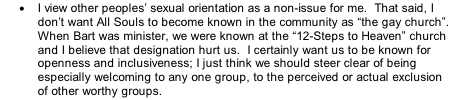
Here's a few additional quotes from All Souls members in the June 2005 report that provide us evidence of this homophobia and heterosexism (text from June 2005 report pasted in as graphics):





Folks, it's pretty disingenuous to say that we're not homophobic and we don't have a problem with gays, but we don't want to be known as the "gay church" in Shreveport.

To examine why this "gay church" concern may suggest that we still have some work to do, it's worth using a resource developed by psychologist Dorothy Riddle:
Riddle Homophobia Scale: Attitudes Toward Differences
In a clinical sense, homophobia is defined as an intense, irrational fear of same sex relationships that becomes overwhelming to the person. In common usage, homophobia is the fear of intimate relationships with persons of the same sex. Below are listed four negative homophobic levels, and four positive levels of attitudes towards lesbian and gay relationships / people. They were developed by Dr. Dorothy Riddle, a psychologist from Tucson, Arizona.

Homophobic Levels of Attitude
Repulsion: Homosexuality is seen as a "crime against nature." Gays/lesbians are sick, crazy, immoral, sinful, wicked, etc. Anything is justified to change them: prison, hospitalization, behavior therapy, electroshock therapy, etc.

Pity: Heterosexual chauvinism. Heterosexuality is more mature and certainly to be preferred. Any possibility of "becoming straight" should be reinforced, and those who seem to be born "that way" should be pitied, "the poor dears."

Tolerance: Homosexuality is just a phase of adolescent development that many people go through and most people "grow out of." Thus, lesbians/gays are less mature than "straights" and should be treated with the protectiveness and indulgence one uses with a child. Lesbians/gays should not be given positions of authority because they are still working through their adolescent behavior.

Acceptance: Still implies there is something to accept. Characterized by such statements as "You're not lesbian to me, you're a person!" or "What you do in bed is your own business." or "That's fine with me as long as you don't flaunt it!"

Positive Levels of Attitudes
Support: The basic ACLU position. Work to safeguard the rights of lesbians and gays. People at this level may be uncomfortable themselves, but they are aware of the homophobic climate and the irrational unfairness.

Admiration: Acknowledges that being lesbian/gay in our society takes strength. People at this level are willing to truly examine their homophobic attitudes, values, and behaviors.

Appreciation: Value the diversity of people and see lesbians/gays as a valid part of that diversity. These people are willing to combat homophobia in themselves and others.

Nurturance: Assumes that gay/lesbian people are indispensable in our society. They view lesbians/gays with genuine affection and delight, and are willing to be allies and advocates.
Source - http://www.d.umn.edu/~hrallis/professional/presentations/ally_training/riddle_scale.htm
My experience with the Welcoming Congregation process suggests that our congregation is stuck at the "tolerance" and "acceptance" positions on the Riddle Scale.

As a congregation, we are a long way from "support" ... especially if we are unwilling to be personally "uncomfortable" (e.g. not willing to be known as the "gay church).

We still have some unresolved work to do on congregational homophobia and heterosexism at All Souls.

27 May 2006

Tim Berners-Lee and Net Neutrality

The Unitarian Universalist computer scientist Tim Berners-Lee has recently started a blog. His most recent post is on the "net neutrality" issue.

As Unitarian Universalists with a committment to affirm and promote the "free and responsible search for truth and meaning," the "net neutrality" issue is important to us.

Here's a brief quote from Tim's blog:
The Internet is increasingly becoming the dominant medium binding us. The neutral communications medium is essential to our society. It is the basis of a fair competitive market economy. It is the basis of democracy, by which a community should decide what to do. It is the basis of science, by which humankind should decide what is true.

Let us protect the neutrality of the net.
... and you can read the rest of it online here.

12 May 2006

NEWS: House Injects Prayer Into Defense Bill

"House Injects Prayer Into Defense Bill" by Alan Cooperman and Ann Scott Tyson (Washington Post Staff Writers - Friday, 12 May 2006 - Page A05 - see the excerpts copied below and this link for the entire article) :

The House passed a $513 billion defense authorization bill yesterday that includes language intended to allow chaplains to pray in the name of Jesus at public military ceremonies, undercutting new Air Force and Navy guidelines on religion.

***

Before the bill reached the House floor, Republicans on the House Armed Services Committee added the provision on military chaplains. It says each chaplain "shall have the prerogative to pray according to the dictates of the chaplain's own conscience, except as must be limited by military necessity, with any such limitation being imposed in the least restrictive manner feasible."

Air Force and Navy rules issued in recent months allow chaplains to pray as they wish in voluntary worship services. But the rules call for nonsectarian prayers, or a moment of silence, at public meetings or ceremonies, especially when attendance is mandatory for service members of all faiths.

Focus on the Family, the Christian Coalition and other evangelical Christian groups have lobbied vigorously against the Air Force and Navy rules, urging President Bush to issue an executive order guaranteeing the right of chaplains to pray in the name of Jesus under any circumstances. Because the White House has not acted, sympathetic members of Congress stepped in.

"We felt there needed to be a clarification" of the rules "because there is political correctness creeping into the chaplains corps," said Rep. Walter B. Jones (R-N.C.). "I don't understand anyone being opposed to a chaplain having the freedom to pray to God in the way his conscience calls him to pray."

Among the provision's opponents is the chief of Navy chaplains, Rear Adm. Louis V. Iasiello, a Roman Catholic priest.

"The language ignores and negates the primary duties of the chaplain to support the religious needs of the entire crew" and "will, in the end, marginalize chaplains and degrade their use and effectiveness," Iasiello wrote in a letter to a committee member.

Book Excerpt from "Kingdom Coming: The Rise of Christian Nationalism"

This is worth checking out ...

Across the United States, religious activists are organizing to establish an American theocracy. A frightening look inside the growing right-wing movement.

Here's a brief snippet of this book excerpt:
A few days before Bush's second inauguration, The New York Times carried a story headlined "Warning from a Student of Democracy's Collapse" about Fritz Stern, a refugee from Nazi Germany, professor emeritus of history at Columbia, and scholar of fascism. It quoted a speech he had given in Germany that drew parallels between Nazism and the American religious right. "Some people recognized the moral perils of mixing religion and politics," he was quoted saying of prewar Germany, "but many more were seduced by it. It was the pseudo-religious transfiguration of politics that largely ensured [Hitler's] success, notably in Protestant areas."

It's not surprising that Stern is alarmed. Reading his forty-five-year-old book "The Politics of Cultural Despair: A Study in the Rise of the Germanic Ideology," I shivered at its contemporary resonance. "The ideologists of the conservative revolution superimposed a vision of national redemption upon their dissatisfaction with liberal culture and with the loss of authoritative faith," he wrote in the introduction. "They posed as the true champions of nationalism, and berated the socialists for their internationalism, and the liberals for their pacifism and their indifference to national greatness."

Fascism isn't imminent in America. But its language and aesthetics are distressingly common among Christian nationalists. History professor Roger Griffin described the "mobilizing vision" of fascist movements as "the national community rising Phoenix-like after a period of encroaching decadence which all but destroyed it" (his italics). The Ten Commandments has become a potent symbol of this dreamed-for resurrection on the American right.

True, our homegrown quasi-fascists often appear so absurd as to seem harmless. Take, for example, American Veterans in Domestic Defense, the organization that took the Ten Commandments on tour. The group says it exists to "neutralize the destructiveness" of America's "domestic enemies," which include "biased liberal, socialist news media," "the ACLU," and "the conspiracy of an immoral film industry." To do this, it aims to recruit former military men. "AVIDD reminds all American Veterans that you took an oath to defend the United States against all enemies, 'both foreign and domestic,'" its Web site says. "In your military capacity, you were called upon to defend the United States against foreign enemies. AVIDD now calls upon you to continue to fulfill your oath and help us defend this nation on the political front, against equally dangerous domestic enemies."

According to Jim Cabaniss, the seventy-two-year-old Korean War veteran who founded AVIDD, the group now has thirty-three chapters across the country. It's entirely likely that some of these chapters just represent one or two men, and as of 2005, AVIDD didn't seem large enough to be much of a danger to anyone.

Still, it's worth noting that thousands of Americans nationwide have flocked to rallies at which military men don uniforms and pledge to seize the reins of power in America on behalf of Christianity. In many places, local religious leaders and politicians lend their support to AVIDD's cause. And at least some of the people at these rallies speak with seething resentment about the tyranny of Jews over America's Christian majority. "People who call themselves Jews represent maybe 2 or 3 percent of our people," Cabaniss told me after a January 2005 rally in Austin. "Christians represent a huge percent, and we don't believe that a small percentage should destroy the values of the larger percentage."


The rest of the excerpt can be read here.

NEWS: United Methodist invitation to Indigo Girls singer draws fire

This item is forwarded from the United Church of Christ News Web Site:
The choice of lesbian singer Emily Saliers of the music duo Indigo Girls as a keynote speaker at the United Methodist Women’s Assembly in Anaheim, Calif., has created controversy.


Saliers spoke May 6 at the conference along with her father, the Rev. Don E. Saliers of Candler School of Theology at Emory University in Atlanta. They addressed an estimated 8,000 women on their new co-written book entitled "A Song to Sing, A Life to Live."


Saliers' sexual orientation has been the topic of controversy for some conservatives, but event organizers instead have cited her "spiritual and theological understandings and (her) commitment to justice for women and children" as reasons for the invitation.


The Indigo Girls have devoted much of their 14 records spanning 18 years to themes of social justice and environmental awareness. The elder Saliers is the author of a dozen books and is president of the North American Academy of Liturgy and the Society for the Study of Christian Spirituality.


Some groups, however, have criticized the church for giving a prominent speaking slot to a lesbian, noting that the Methodists' constitution says the church cannot "condone the practice of homosexuality and considers this practice incompatible with Christian teaching."


"...Even if Ms. Saliers does not openly advocate for the acceptance of homosexual practice in the Assembly presentations, her public recognition as a lesbian icon puts the Women's Division in the place of endorsing the lesbian lifestyle and of offending the women of the church," said Faye Short, president of RENEW, a conservative women's organization.


The Indigo Girls won a Grammy award for "Best Contemporary Folk Recording" in 1989. Singer Amy Ray is the other half of the duo.
Someone needs to explain to me why God cares so much about our sexual orientations.

I guess the RENEW leadership and other conservative Christians know what God would want done if God had all the facts at hand.

01 May 2006

The truthiness hurts

Worth checking out ...

Colbert's smart bomb (White House Correspondents' Association Dinner video clip)

Dining on the press corps (White House Correspondents' Association Dinner video clip)

The truthiness hurts (salon.com analysis of Stephen Cobert's comments)
Stephen Colbert's brilliant performance unplugged the Bush myth machine -- and left the clueless D.C. press corps gaping