09 October 2006
The Scientologists Get Tom Cruise and The Fundamentalist Christians Are Stuck With This Guy ...
Check out how a washed-up Hollywood actor finds religion, condemns Bono for promoting Third World debt relief, and is advising the President ... click here for the salon.com article.
07 October 2006
An Open Letter to Sen. Brownback (R - Kansas)
Below is an email that I sent to Senator Brownback in response to his criticism of Judge Neff's participation in a United Church of Christ holy union ceremony in 2002:
Sen. Brownback,
This email is in reply to the news coverage surrounding your criticism of Judge Janet T. Neff and her participation in a holy union ceremony in a United Church of Christ religious setting.
Judge Neff was taking part in a religious ceremony that is grounded in the United Church of Christ's understanding of God, Jesus, and the Bible.
Article VI of the US Constitution states that " ... no religious Test shall ever be required as a Qualification to any Office or public Trust under the United States" and your criticism of Judge Neff's religious beliefs would be a religious test.
It's my understanding that the US Constitution expressly forbids religious disqualification for judicial nominees and your endorsement of religious disqualification shows that you have no respect for our nation, our constitution, and the values of religious freedom that most Americans share.
With your suggestion that participation in a same-sex holy union ceremony would disqualify someone from serving as a federal judge, you have disqualified many liberal Christians, liberal Jews, members of the United Church of Christ churches, and members of Unitarian Universalist Churches from serving as judges.
To see my religious faith as a Unitarian Universalist and the faith of our United Church of Christ neighbors treated this way tells me that you have no respect for the Constitution, our laws, or religious freedom.
Sincerely,
Steve Caldwell
19 September 2006
George Allen's Anger Over Jewish "Aspersions"
This salon.com commentary about the Virginia Senate race says a lot about George Allen. I'm posting the commentary in its entirety:
George Allen and the "aspersion" of Judaism
George Allen and the "aspersion" of Judaism
George Allen insists that he didn't mean anything by it when he called an Indian-American college student "macaca." But when a reporter asks Allen whether some of his ancestors were Jewish -- well, now, that's an "aspersion" worthy of boos, hisses and public condemnation.
The question came up Monday as Allen debated Jim Webb in Tysons Corner, Va. Allen, asked yet again about his "macaca" moment, underscored his long-standing belief in tolerance and acceptance -- all those Confederate flags notwithstanding -- by noting that his grandfather had been "incarcerated by the Nazis in World War II." WUSA-TV's Peggy Fox followed up by noting that Allen's grandfather was Jewish and asking him "at what point" his family's "Jewish identity" may have ended.
As the Washington Post's Dana Milbank reports, Allen "recoiled as if he had been struck," and his supporters in the audience "hissed and booed." Allen, who likes to say he was raised on the "four Fs" -- faith, family, freedom and football --demanded to know why religion was relevant in the Senate race. He told Fox to "ask questions about issues that really matter to people here in Virginia" and to stop "making aspersions" about him.
Fox says she was just looking for "honesty" from Allen, a Californian by birth who has reinvented himself as a cowboy-boot-wearing, tobacco-chewing Southern darling of the religious right. And while Milbank says that Fox's question may have seemed a little out of place at a candidate's debate, Allen's wrath seemed entirely out of proportion to the provocation. He said he was glad that the crowd had booed Fox, and he accused her of "making aspersions about people because of their religious beliefs." Even after the debate ended, Allen was still fuming. When somebody asked why Fox's question had made him so angry, he shot back: "What do you mean, 'make me so angry'?" He complained about Fox's attempt to bring his family's history into the debate -- then mentioned again that his grandfather had been "incarcerated by the Nazis in World War II."
So why is Allen so upset? It seems pretty simple to us. When you paint yourself as one with rednecks and racists -- wrapping yourself in the Confederate flag, hanging a noose from your office tree, cozying up to the modern version of the Ku Klux Klan, calling out the dark-skinned college kid in your midst -- you don't take it kindly when someone asks whether you might be on the other side of the line you've been drawing.
Macaca is always the other guy. It can't possibly be me.
26 July 2006
Susie Bright and Greta Christina -- Commentary on Awestruck Skepticism
I would recommend reading Greta Christina's blog and Susie Bright's blog commentary on transcendent skepticism.
I think it's relevant to the "language of reverence" discussions happening in Unitarian Universalism and what role that skeptical Humanists will have in developing a language of reverence. Here's a brief sample from Susie Bright's blog where she quotes Greta's blog:
I think it's relevant to the "language of reverence" discussions happening in Unitarian Universalism and what role that skeptical Humanists will have in developing a language of reverence. Here's a brief sample from Susie Bright's blog where she quotes Greta's blog:
Blogger Greta Christina has just lost her temper with notion that "God is in the details," as lovely as that may sound from a lyrical perspective.It is entirely possible to be a skeptic, an agnostic, and/or an atheist— regarding all metaphysical beliefs, not just deities or organized religions— and still lead a rich, satisfying life, full of creativity and connection and love.
More to the point, it is possible to be a skeptic, an agnostic, and/or an atheist, and still experience awestruck wonder at the mysterious majesty of the universe, and a feeling of transcendent oneness with it.
09 July 2006
"Follow The Money" - Episcopal Diocese of Washington DC Report on the IRD
More info on IRD political dirty tricks ...
When the General Convention of the Episcopal Church meets June 13 in Columbus, Ohio, a small network of theologically conservative organizations will be on hand to warn deputies that they must repent of their liberal attitudes on homosexuality or face serious consequences. The groups represent a small minority of church members, but relationships with wealthy American donors and powerful African bishops have made them key players in the fight for the future of the Anglican Communion.The entire report can be downloaded here (requires Adobe Acrobat or other PDF reader software).
IRD and Political Dirty Tricks in Religion
This blog excerpt comes from Rev. Susan Russell's blog where she is quoting Peter Laarman's recent column "A Canterbury Tale: U.S. Episcopalians in Manufactured Schism."
Rev. Russell is President of Integrity, the Episcopal Church's "leading grassroots voice for the full inclusion of LGBT (Lesbian, Gay, Bisexual, and Transgender) persons in the Episcopal Church and our equal access to its rites."
Here's the interesting excerpt.
I suspect the reason that the IRD isn't interested in creating schism within the UUA is we just aren't big enough to worry about. If we were to grow larger as a denomination, I wouldn't be surprised to see IRD support of schism movements within the UUA.
Rev. Russell is President of Integrity, the Episcopal Church's "leading grassroots voice for the full inclusion of LGBT (Lesbian, Gay, Bisexual, and Transgender) persons in the Episcopal Church and our equal access to its rites."
Here's the interesting excerpt.
It's the old liberals' dilemma, ecclesiastical version. They fight dirty; we don't. They organize; we temporize. They seize the pendulum and give it a rightward shove; we wait meekly for the pendulum to swing back.The IRD covert involvement in creating schism in Mainline Protestant Churches as a way to neutralize their prophetic voices for social justice has been very successful. Our Congregationalist cousins in the United Church of Christ are dealing with their IRD-supported schism called the Biblical Witness Fellowship.
The liberals could at least point out -- and I hope that Bishop Jefferts Schori will be the first to do so -- how shamelessly the rift within the U.S. denomination has been manipulated and exacerbated for many years by a little-known but well-financed and quite deadly operation called the Institute for Religion and Democracy (IRD).
Created by cunning Schactmanites and by ex-CIA operatives during the time of Reagan's dirty wars in Central America, the IRD's core work plan has always called for dividing and disabling the larger Mainline Protestant denominations -- the Episcopalians, Presbyterians, United Methodists, and Evangelical Lutherans -- using any means necessary. The means that has worked best by far is relentlessly flogging the issue of homosexuality and accusing religious progressives of departing from the true faith by preaching that God really does love everybody.
Thanks to the IRD's skillful fingering of this hot button through the different front groups it operates within each body, all four national denominations have been pretty much AWOL from the more urgent moral debates this moment: e.g., imperial wars of choice, torture, civil liberties, Katrina, climate change, and economic terrorism from above. The denoms just don't have the energy. Nearly all their attention and focus have been consumed by internal debates on matters Levitical.
I was reliably informed that the IRD operated right out in the open at the Episcopal convention back there in Columbus. And why shouldn't they crawl out of the woodwork and get kinda jiggy at this point? In Ohio they scored their biggest coup in a quarter-century of patient stalinoid boring from within.
One final irony: several of the guiding spirits in forming the IRD went on to create the intellectual foundations of the Bush-Cheney "dominance doctrine." So it's not that these folks doubt for one minute that Americans should rule the world; they are in fact quite passionately committed to taking up the White Man's Burden. It's just that in order for American dominance to be secured against all possible sources of domestic opposition, the liberal churches needed to be silenced. And for this purpose, what better CIA-like cover could possibly be contrived than multicultural deference to the spiritual interests and biblical views of the very same ex-colonials -- Africans, Asians, and Latins -- whose material interests and worldly aspirations our peerless American Empire will continue to shunt aside with total and utter contempt.
I suspect the reason that the IRD isn't interested in creating schism within the UUA is we just aren't big enough to worry about. If we were to grow larger as a denomination, I wouldn't be surprised to see IRD support of schism movements within the UUA.
07 July 2006
Interview with Sam Harris (Author of "The End of Faith")
Salon.com has an interview with Sam Harris:
Sam Harris isn't totally anti-religious. His criticism is mostly directed towards scripture-based God-of-Abraham monotheism. With our historical roots in this tradition, this book might be a good resource for a book discussion group to explore how to responsibly exist in our tradition.
Here's a brief quote from the Salon.com interview where he talks about Buddhism:
The disbeliever
Sam Harris, author of "The End of Faith," on why religious moderates are worse than fundamentalists, 9/11 led us into a deranged holy war, and believers should be treated like alien-abduction kooks.
Sam Harris isn't totally anti-religious. His criticism is mostly directed towards scripture-based God-of-Abraham monotheism. With our historical roots in this tradition, this book might be a good resource for a book discussion group to explore how to responsibly exist in our tradition.
Here's a brief quote from the Salon.com interview where he talks about Buddhism:
You can't get the same kind of death cult brewing in Buddhism, or at least not as readily. And that's why we don't see Tibetan Buddhist suicide bombers.
You know, the Tibetans have suffered a terrible occupation under the Chinese. Many people estimate that 1.1 or 1.2 million Tibetans have died as a result of that occupation. We should see Tibetan Buddhists blowing themselves up on Chinese buses, if all religions are equivalent. But we don't see that. What we do see in Tibetan Buddhism -- which is impossible to even imagine in Islam at the moment -- we see Tibetans who have been tortured for decades in Chinese prisons, coming out and saying things like, "My greatest fear while I was in prison was that I would lose the strength of my compassion and come to hate my torturers." Now, that said, there's nothing in Buddhism that's held dogmatically that I would support. It's just that all dogmas are not equal and don't have equal behavioral consequences.
25 June 2006
General Assembly Workshop on 2005 Closing Ceremony Events
This was added to the Unitarian Universalist Assocation's 2006 General Assembly web pages today:
The Special Review Commission Final Report can be found online here (requires Adobe Acrobat Reader or other PDF reader software).
The Special Review Commission held this workshop as a forum for further conversation about events that occurred during and prior to General Assembly in Fort Worth, Texas in June, 2005. The Board of Trustees of the Unitarian Universalist Association (UUA) formed the Commission following last year's General Assembly, charging the Commission "to review the trajectory of events which impacted the Unitarian Universalist community of color, especially the youth of color community, leading up to and during the Fort Worth General Assembly." This complex series of racially-charged events revealed racist attitudes among Unitarian Universalists.The rest of the workshop summary can be found online here.
The Special Review Commission Final Report can be found online here (requires Adobe Acrobat Reader or other PDF reader software).
24 June 2006
Welcoming Congregation Failure -- Looking Back After One Year
I've been thinking about the Welcoming Congregation failure we experienced in Spring 2005 at All Souls Unitarian Universalist Church in Shreveport, Louisiana.
I'm also curious about when or if we are going to re-examine the Welcoming Congregation program at All Souls.
The following text is copied from the June 2005 Advisory Commission Report on Welcoming Congregation conflicts (text pasted in as a graphic):

[Note: The entire report can be read online here. This file requires Adobe Acrobat Reader or other compatible PDF reader software.]
It's been over a year since report was released to the congregation and our settled minister has been at All Souls for nearly a year. I suspect that she has a good idea about who we are and what our congregational life is like.
I would suggest that we need to start talking about Welcoming Congregation again at All Souls.
As a congregation, we stumbled very badly in our internal reflection and study of homophobia, heterosexism, and oppression at All Souls.
I know that our retreat from this social justice issue has led to a loss of some members and the perception by some in the non-Unitarian Universalist Shreveport bisexual, gay, lesbian, and transgender communities that we're not living up to our ideals as a congregation that affirms the worth and dignity of every person along with justice, equality, and compassion in our relationships.
It's also hurt me personally as well and has caused me to question if I really fit in here as a member of this congregation.
I suspect that our failure is affecting our congregational growth in Shreveport ... especially when we compare ourselves to our nearest UU neighbors in Longview TX (who are growing at 10-15% a year and had to purchase a new worship space in order to comply with building fire code occupancy requirements on Sunday mornings).
In a larger sense, we may want to ask ourselves why we are not experiencing the sort of growth one sees in the Longview congregation. Perhaps we should send some of our folks to visit them on Sunday and see what they have done that is different from All Souls?
There is plenty of evidence that we still have work to do internally with our congregation's attitudes towards homophobia and heterosexism.
Here's a few additional quotes from All Souls members in the June 2005 report that provide us evidence of this homophobia and heterosexism (text from June 2005 report pasted in as graphics):




Folks, it's pretty disingenuous to say that we're not homophobic and we don't have a problem with gays, but we don't want to be known as the "gay church" in Shreveport.
To examine why this "gay church" concern may suggest that we still have some work to do, it's worth using a resource developed by psychologist Dorothy Riddle:
As a congregation, we are a long way from "support" ... especially if we are unwilling to be personally "uncomfortable" (e.g. not willing to be known as the "gay church).
We still have some unresolved work to do on congregational homophobia and heterosexism at All Souls.
I'm also curious about when or if we are going to re-examine the Welcoming Congregation program at All Souls.
The following text is copied from the June 2005 Advisory Commission Report on Welcoming Congregation conflicts (text pasted in as a graphic):

[Note: The entire report can be read online here. This file requires Adobe Acrobat Reader or other compatible PDF reader software.]
It's been over a year since report was released to the congregation and our settled minister has been at All Souls for nearly a year. I suspect that she has a good idea about who we are and what our congregational life is like.
I would suggest that we need to start talking about Welcoming Congregation again at All Souls.
As a congregation, we stumbled very badly in our internal reflection and study of homophobia, heterosexism, and oppression at All Souls.
I know that our retreat from this social justice issue has led to a loss of some members and the perception by some in the non-Unitarian Universalist Shreveport bisexual, gay, lesbian, and transgender communities that we're not living up to our ideals as a congregation that affirms the worth and dignity of every person along with justice, equality, and compassion in our relationships.
It's also hurt me personally as well and has caused me to question if I really fit in here as a member of this congregation.
I suspect that our failure is affecting our congregational growth in Shreveport ... especially when we compare ourselves to our nearest UU neighbors in Longview TX (who are growing at 10-15% a year and had to purchase a new worship space in order to comply with building fire code occupancy requirements on Sunday mornings).
In a larger sense, we may want to ask ourselves why we are not experiencing the sort of growth one sees in the Longview congregation. Perhaps we should send some of our folks to visit them on Sunday and see what they have done that is different from All Souls?
There is plenty of evidence that we still have work to do internally with our congregation's attitudes towards homophobia and heterosexism.
Here's a few additional quotes from All Souls members in the June 2005 report that provide us evidence of this homophobia and heterosexism (text from June 2005 report pasted in as graphics):



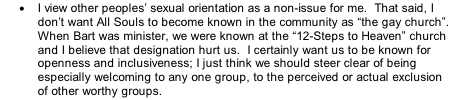
Folks, it's pretty disingenuous to say that we're not homophobic and we don't have a problem with gays, but we don't want to be known as the "gay church" in Shreveport.
To examine why this "gay church" concern may suggest that we still have some work to do, it's worth using a resource developed by psychologist Dorothy Riddle:
Riddle Homophobia Scale: Attitudes Toward DifferencesMy experience with the Welcoming Congregation process suggests that our congregation is stuck at the "tolerance" and "acceptance" positions on the Riddle Scale.
In a clinical sense, homophobia is defined as an intense, irrational fear of same sex relationships that becomes overwhelming to the person. In common usage, homophobia is the fear of intimate relationships with persons of the same sex. Below are listed four negative homophobic levels, and four positive levels of attitudes towards lesbian and gay relationships / people. They were developed by Dr. Dorothy Riddle, a psychologist from Tucson, Arizona.
Homophobic Levels of Attitude
Repulsion: Homosexuality is seen as a "crime against nature." Gays/lesbians are sick, crazy, immoral, sinful, wicked, etc. Anything is justified to change them: prison, hospitalization, behavior therapy, electroshock therapy, etc.
Pity: Heterosexual chauvinism. Heterosexuality is more mature and certainly to be preferred. Any possibility of "becoming straight" should be reinforced, and those who seem to be born "that way" should be pitied, "the poor dears."
Tolerance: Homosexuality is just a phase of adolescent development that many people go through and most people "grow out of." Thus, lesbians/gays are less mature than "straights" and should be treated with the protectiveness and indulgence one uses with a child. Lesbians/gays should not be given positions of authority because they are still working through their adolescent behavior.
Acceptance: Still implies there is something to accept. Characterized by such statements as "You're not lesbian to me, you're a person!" or "What you do in bed is your own business." or "That's fine with me as long as you don't flaunt it!"
Positive Levels of Attitudes
Support: The basic ACLU position. Work to safeguard the rights of lesbians and gays. People at this level may be uncomfortable themselves, but they are aware of the homophobic climate and the irrational unfairness.
Admiration: Acknowledges that being lesbian/gay in our society takes strength. People at this level are willing to truly examine their homophobic attitudes, values, and behaviors.
Appreciation: Value the diversity of people and see lesbians/gays as a valid part of that diversity. These people are willing to combat homophobia in themselves and others.
Nurturance: Assumes that gay/lesbian people are indispensable in our society. They view lesbians/gays with genuine affection and delight, and are willing to be allies and advocates.
Source - http://www.d.umn.edu/~hrallis/professional/presentations/ally_training/riddle_scale.htm
As a congregation, we are a long way from "support" ... especially if we are unwilling to be personally "uncomfortable" (e.g. not willing to be known as the "gay church).
We still have some unresolved work to do on congregational homophobia and heterosexism at All Souls.
27 May 2006
Tim Berners-Lee and Net Neutrality
The Unitarian Universalist computer scientist Tim Berners-Lee has recently started a blog. His most recent post is on the "net neutrality" issue.
As Unitarian Universalists with a committment to affirm and promote the "free and responsible search for truth and meaning," the "net neutrality" issue is important to us.
Here's a brief quote from Tim's blog:
As Unitarian Universalists with a committment to affirm and promote the "free and responsible search for truth and meaning," the "net neutrality" issue is important to us.
Here's a brief quote from Tim's blog:
The Internet is increasingly becoming the dominant medium binding us. The neutral communications medium is essential to our society. It is the basis of a fair competitive market economy. It is the basis of democracy, by which a community should decide what to do. It is the basis of science, by which humankind should decide what is true.... and you can read the rest of it online here.
Let us protect the neutrality of the net.
12 May 2006
NEWS: House Injects Prayer Into Defense Bill
"House Injects Prayer Into Defense Bill" by Alan Cooperman and Ann Scott Tyson (Washington Post Staff Writers - Friday, 12 May 2006 - Page A05 - see the excerpts copied below and this link for the entire article) :
The House passed a $513 billion defense authorization bill yesterday that includes language intended to allow chaplains to pray in the name of Jesus at public military ceremonies, undercutting new Air Force and Navy guidelines on religion.
***
Before the bill reached the House floor, Republicans on the House Armed Services Committee added the provision on military chaplains. It says each chaplain "shall have the prerogative to pray according to the dictates of the chaplain's own conscience, except as must be limited by military necessity, with any such limitation being imposed in the least restrictive manner feasible."
Air Force and Navy rules issued in recent months allow chaplains to pray as they wish in voluntary worship services. But the rules call for nonsectarian prayers, or a moment of silence, at public meetings or ceremonies, especially when attendance is mandatory for service members of all faiths.
Focus on the Family, the Christian Coalition and other evangelical Christian groups have lobbied vigorously against the Air Force and Navy rules, urging President Bush to issue an executive order guaranteeing the right of chaplains to pray in the name of Jesus under any circumstances. Because the White House has not acted, sympathetic members of Congress stepped in.
"We felt there needed to be a clarification" of the rules "because there is political correctness creeping into the chaplains corps," said Rep. Walter B. Jones (R-N.C.). "I don't understand anyone being opposed to a chaplain having the freedom to pray to God in the way his conscience calls him to pray."
Among the provision's opponents is the chief of Navy chaplains, Rear Adm. Louis V. Iasiello, a Roman Catholic priest.
"The language ignores and negates the primary duties of the chaplain to support the religious needs of the entire crew" and "will, in the end, marginalize chaplains and degrade their use and effectiveness," Iasiello wrote in a letter to a committee member.
Book Excerpt from "Kingdom Coming: The Rise of Christian Nationalism"
This is worth checking out ...
Across the United States, religious activists are organizing to establish an American theocracy. A frightening look inside the growing right-wing movement.
Here's a brief snippet of this book excerpt:
The rest of the excerpt can be read here.
Across the United States, religious activists are organizing to establish an American theocracy. A frightening look inside the growing right-wing movement.
Here's a brief snippet of this book excerpt:
A few days before Bush's second inauguration, The New York Times carried a story headlined "Warning from a Student of Democracy's Collapse" about Fritz Stern, a refugee from Nazi Germany, professor emeritus of history at Columbia, and scholar of fascism. It quoted a speech he had given in Germany that drew parallels between Nazism and the American religious right. "Some people recognized the moral perils of mixing religion and politics," he was quoted saying of prewar Germany, "but many more were seduced by it. It was the pseudo-religious transfiguration of politics that largely ensured [Hitler's] success, notably in Protestant areas."
It's not surprising that Stern is alarmed. Reading his forty-five-year-old book "The Politics of Cultural Despair: A Study in the Rise of the Germanic Ideology," I shivered at its contemporary resonance. "The ideologists of the conservative revolution superimposed a vision of national redemption upon their dissatisfaction with liberal culture and with the loss of authoritative faith," he wrote in the introduction. "They posed as the true champions of nationalism, and berated the socialists for their internationalism, and the liberals for their pacifism and their indifference to national greatness."
Fascism isn't imminent in America. But its language and aesthetics are distressingly common among Christian nationalists. History professor Roger Griffin described the "mobilizing vision" of fascist movements as "the national community rising Phoenix-like after a period of encroaching decadence which all but destroyed it" (his italics). The Ten Commandments has become a potent symbol of this dreamed-for resurrection on the American right.
True, our homegrown quasi-fascists often appear so absurd as to seem harmless. Take, for example, American Veterans in Domestic Defense, the organization that took the Ten Commandments on tour. The group says it exists to "neutralize the destructiveness" of America's "domestic enemies," which include "biased liberal, socialist news media," "the ACLU," and "the conspiracy of an immoral film industry." To do this, it aims to recruit former military men. "AVIDD reminds all American Veterans that you took an oath to defend the United States against all enemies, 'both foreign and domestic,'" its Web site says. "In your military capacity, you were called upon to defend the United States against foreign enemies. AVIDD now calls upon you to continue to fulfill your oath and help us defend this nation on the political front, against equally dangerous domestic enemies."
According to Jim Cabaniss, the seventy-two-year-old Korean War veteran who founded AVIDD, the group now has thirty-three chapters across the country. It's entirely likely that some of these chapters just represent one or two men, and as of 2005, AVIDD didn't seem large enough to be much of a danger to anyone.
Still, it's worth noting that thousands of Americans nationwide have flocked to rallies at which military men don uniforms and pledge to seize the reins of power in America on behalf of Christianity. In many places, local religious leaders and politicians lend their support to AVIDD's cause. And at least some of the people at these rallies speak with seething resentment about the tyranny of Jews over America's Christian majority. "People who call themselves Jews represent maybe 2 or 3 percent of our people," Cabaniss told me after a January 2005 rally in Austin. "Christians represent a huge percent, and we don't believe that a small percentage should destroy the values of the larger percentage."
The rest of the excerpt can be read here.
NEWS: United Methodist invitation to Indigo Girls singer draws fire
This item is forwarded from the United Church of Christ News Web Site:
I guess the RENEW leadership and other conservative Christians know what God would want done if God had all the facts at hand.
The choice of lesbian singer Emily Saliers of the music duo Indigo Girls as a keynote speaker at the United Methodist Women’s Assembly in Anaheim, Calif., has created controversy.Someone needs to explain to me why God cares so much about our sexual orientations.
Saliers spoke May 6 at the conference along with her father, the Rev. Don E. Saliers of Candler School of Theology at Emory University in Atlanta. They addressed an estimated 8,000 women on their new co-written book entitled "A Song to Sing, A Life to Live."
Saliers' sexual orientation has been the topic of controversy for some conservatives, but event organizers instead have cited her "spiritual and theological understandings and (her) commitment to justice for women and children" as reasons for the invitation.
The Indigo Girls have devoted much of their 14 records spanning 18 years to themes of social justice and environmental awareness. The elder Saliers is the author of a dozen books and is president of the North American Academy of Liturgy and the Society for the Study of Christian Spirituality.
Some groups, however, have criticized the church for giving a prominent speaking slot to a lesbian, noting that the Methodists' constitution says the church cannot "condone the practice of homosexuality and considers this practice incompatible with Christian teaching."
"...Even if Ms. Saliers does not openly advocate for the acceptance of homosexual practice in the Assembly presentations, her public recognition as a lesbian icon puts the Women's Division in the place of endorsing the lesbian lifestyle and of offending the women of the church," said Faye Short, president of RENEW, a conservative women's organization.
The Indigo Girls won a Grammy award for "Best Contemporary Folk Recording" in 1989. Singer Amy Ray is the other half of the duo.
I guess the RENEW leadership and other conservative Christians know what God would want done if God had all the facts at hand.
01 May 2006
The truthiness hurts
Worth checking out ...
Colbert's smart bomb (White House Correspondents' Association Dinner video clip)
Dining on the press corps (White House Correspondents' Association Dinner video clip)
The truthiness hurts (salon.com analysis of Stephen Cobert's comments)
Stephen Colbert's brilliant performance unplugged the Bush myth machine -- and left the clueless D.C. press corps gaping
Colbert's smart bomb (White House Correspondents' Association Dinner video clip)
Dining on the press corps (White House Correspondents' Association Dinner video clip)
The truthiness hurts (salon.com analysis of Stephen Cobert's comments)
Stephen Colbert's brilliant performance unplugged the Bush myth machine -- and left the clueless D.C. press corps gaping
27 April 2006
Carl Sagan's "Baloney Detection Kit"
One of our sources for our living tradition are "Humanist teachings which counsel us to heed the guidance of reason and the results of science, and warn us against idolatries of the mind and spirit."
In the spirit of our Humanist tradition within Unitarian Universalism, I'm posting a version of the "Baloney Detection Kit" from Carl Sagan's The Demon Haunted World.
The following are suggested as tools for testing arguments and detecting fallacious or fraudulent arguments:
Wherever possible there must be independent confirmation of the facts.
Encourage substantive debate on the evidence by knowledgeable proponents of all points of view.
Arguments from authority carry little weight (in science there are no "authorities").
Spin more than one hypothesis - don't simply run with the first idea that caught your fancy.
Try not to get overly attached to a hypothesis just because it's yours.
Quantify, wherever possible.
If there is a chain of argument every link in the chain must work.
Occam's razor - if there are two hypotheses that explain the data equally well choose the simpler.
Ask whether the hypothesis can, at least in principle, be falsified (shown to be false by some unambiguous test). In other words, it is testable? Can others duplicate the experiment and get the same result?
Additional issues are:
Conduct control experiments - especially "double blind" experiments where the person taking measurements is not aware of the test and control subjects.
Check for confounding factors - separate the variables.
Common fallacies of logic and rhetoric
Ad hominem - attacking the arguer and not the argument.
Argument from "authority".
Argument from adverse consequences (putting pressure on the decision maker by pointing out dire consequences of an "unfavorable" decision).
Appeal to ignorance (absence of evidence is not evidence of absence).
Special pleading (typically referring to god's will).
Begging the question (assuming an answer in the way the question is phrased).
Observational selection (counting the hits and forgetting the misses).
Statistics of small numbers (such as drawing conclusions from inadequate sample sizes).
Misunderstanding the nature of statistics (President Eisenhower expressing astonishment and alarm on discovering that fully half of all Americans have below average intelligence!)
Inconsistency (e.g. military expenditures based on worst case scenarios but scientific projections on environmental dangers thriftily ignored because they are not "proved").
Non sequitur - "it does not follow" - the logic falls down.
Post hoc, ergo propter hoc - "it happened after so it was caused by" - confusion of cause and effect.
Meaningless question ("what happens when an irresistible force meets an immovable object?).
Excluded middle - considering only the two extremes in a range of possibilities (making the "other side" look worse than it really is).
Short-term v. long-term - a subset of excluded middle ("why pursue fundamental science when we have so huge a budget deficit?").
Slippery slope - a subset of excluded middle - unwarranted extrapolation of the effects (give an inch and they will take a mile).
Confusion of correlation and causation.
Caricaturing (or stereotyping) a position to make it easier to attack.
Suppressed evidence or half-truths.
Weasel words - for example, use of euphemisms for war such as "police action" to get around limitations on Presidential powers. "An important art of politicians is to find new names for institutions which under old names have become odious to the public."
In the spirit of our Humanist tradition within Unitarian Universalism, I'm posting a version of the "Baloney Detection Kit" from Carl Sagan's The Demon Haunted World.
The following are suggested as tools for testing arguments and detecting fallacious or fraudulent arguments:
Wherever possible there must be independent confirmation of the facts.
Encourage substantive debate on the evidence by knowledgeable proponents of all points of view.
Arguments from authority carry little weight (in science there are no "authorities").
Spin more than one hypothesis - don't simply run with the first idea that caught your fancy.
Try not to get overly attached to a hypothesis just because it's yours.
Quantify, wherever possible.
If there is a chain of argument every link in the chain must work.
Occam's razor - if there are two hypotheses that explain the data equally well choose the simpler.
Ask whether the hypothesis can, at least in principle, be falsified (shown to be false by some unambiguous test). In other words, it is testable? Can others duplicate the experiment and get the same result?
Additional issues are:
Conduct control experiments - especially "double blind" experiments where the person taking measurements is not aware of the test and control subjects.
Check for confounding factors - separate the variables.
Common fallacies of logic and rhetoric
Ad hominem - attacking the arguer and not the argument.
Argument from "authority".
Argument from adverse consequences (putting pressure on the decision maker by pointing out dire consequences of an "unfavorable" decision).
Appeal to ignorance (absence of evidence is not evidence of absence).
Special pleading (typically referring to god's will).
Begging the question (assuming an answer in the way the question is phrased).
Observational selection (counting the hits and forgetting the misses).
Statistics of small numbers (such as drawing conclusions from inadequate sample sizes).
Misunderstanding the nature of statistics (President Eisenhower expressing astonishment and alarm on discovering that fully half of all Americans have below average intelligence!)
Inconsistency (e.g. military expenditures based on worst case scenarios but scientific projections on environmental dangers thriftily ignored because they are not "proved").
Non sequitur - "it does not follow" - the logic falls down.
Post hoc, ergo propter hoc - "it happened after so it was caused by" - confusion of cause and effect.
Meaningless question ("what happens when an irresistible force meets an immovable object?).
Excluded middle - considering only the two extremes in a range of possibilities (making the "other side" look worse than it really is).
Short-term v. long-term - a subset of excluded middle ("why pursue fundamental science when we have so huge a budget deficit?").
Slippery slope - a subset of excluded middle - unwarranted extrapolation of the effects (give an inch and they will take a mile).
Confusion of correlation and causation.
Caricaturing (or stereotyping) a position to make it easier to attack.
Suppressed evidence or half-truths.
Weasel words - for example, use of euphemisms for war such as "police action" to get around limitations on Presidential powers. "An important art of politicians is to find new names for institutions which under old names have become odious to the public."
Louisiana Abortion Ban Passes in State Senate
This article comes from Jeff Crouere, a local political journalist in Louisiana:
The scary thing about this bill is that a majority of the legislature rejected amendments to this bill that would have allowed for exceptions in cases of rape or incest.Yesterday, the Louisiana State Senate approved by a vote of 30-7, Senate Bill 33, authored by Senator Ben Nevers (D-Bogalusa), which would outlaw all abortions in the state except when the life of the mother is in danger. The bill would subject the abortionist to criminal penalties, not the woman undergoing the abortion. This follows an abortion ban that was passed in South Dakota earlier in the year. Pro-life measures are not being introduced in multiple states as anti-abortion advocates try to take advantage of momentum in this divisive issue.
By a 20-17 vote, the Senate turned down an amendment to the bill that would have added exceptions for rape and incest. Back in 1991, the Legislature passed a law that banned abortions except in the case of rape, incest and when the life of the mother was in danger. The 1991 law was signed by Governor Roemer, but later reversed in federal court. This time, supporters of Nevers’ bill believe it will pass court tests because it is not scheduled to take effect until Roe v. Wade, the 1973 Supreme Court decision legalizing abortion, is overturned.
With the appointment of Justices Alito and Roberts, the Supreme Court is definitely more conservative and more likely to overturn Roe v. Wade, but most analysts believe that a pro-life majority does not yet exist on the court. One more conservative Supreme Court Justice is probably needed for a pro-life majority and that could come if President Bush is given an opportunity to make another court appointment.Louisiana is one of the most pro-life states in the country. A large majority of voters in Louisiana are opposed to abortion. The state has a large Catholic and evangelical Christian population. In Louisiana, almost all Republicans and most Democrats who are elected to statewide office are pro-life. Governor Kathleen Blanco, a pro-life Democrat, likes the Nevers’ bill because it does not take effect until Roe v. Wade is overturned. Blanco knows the electorate in the state and will not risk the negative political ramifications of vetoing the bill. Back in 1991, then Governor Buddy Roemer vetoed an anti-abortion bill with no exceptions. He was never forgiven by pro-life voters and the controversy contributed to his defeat at the polls later that year. Blanco does not want the same problems one year before her re-election campaign.
Blanco “likes” the provision in the Nevers’ bill which mandates that it take effect only after the Supreme Court has overturned Roe v. Wade. Blanco believes that it is “realistic” because it will preclude lengthy and costly court challenges to the law. The bill now moves to the State House, where a pitched battle is certain to occur.
26 April 2006
Louisiana State Senate Voting to Ban Abortion Today (26 April 2006)
On Wednesday, 26 April 2006, the Louisiana State Senate will vote on SB 33 -- a bill that would criminalize abortion in Louisiana.
Here's a description of the proposed law from the KATC TV News web site:
URGENT! SB 33 on the Senate Floor Wednesday, 4/26!
Here's a description of the proposed law from the KATC TV News web site:
La. lawmaker expects a fight over abortion billIf you're interested in working to defeat this proposed law, Planned Parenthood of Louisiana and the Mississippi Delta has pro-choice advocacy information here:
BATON ROUGE, La. -- State senators disagree over a bill that would outlaw nearly all abortions, and several will probably try to add exceptions for victims of rape and incest when it comes up for a vote on Wednesday, the measure's sponsor said.
Sen. Ben Nevers' bill would allow abortions only to save the life of the mother. He said he knows of several senators who will attempt to amend it to add the two additional exceptions. Sen. Joel Chaisson, D-Destrehan, a supporter, has said he feared the measure would not get support of the full Legislature unless the exceptions were added.
Nevers said he would fight any such change. He said he agrees with churches and religious groups -- backers of the bill -- that it should be "as pro-life as it can be."
"They want a bill that has the least exceptions, one that would protect as many unborn lives as we can," said Nevers, D-Bogalusa.
Under the measure, doctors found guilty of performing abortions would face up to 10 years in prison and fines of $100,000.
Opponents include Planned Parenthood, which held a rally on the Capitol steps Tuesday and lobbied senators to vote against the bill.
The bill is set for Senate floor debate on Wednesday afternoon.
The measure is similar to a South Dakota law passed earlier this year that is expected to land before the U.S. Supreme Court. If the high court takes up such an appeal, it would constitute a reconsideration of its 1973 Roe v. Wade ruling that established the right to an abortion. A majority of the Supreme Court's nine justices have voted to uphold Roe v. Wade in the past.
Nevers said some opposition to the measure has disappeared because he amended it to allay concerns that the bill would provoke lawsuits -- and cost the state money -- if it passed. Nevers changed the measure to give it a "trigger" mechanism, meaning it would only go into effect if Roe v. Wade is overturned or if a federal constitutional amendment outlawing abortion is ratified.
Nevers said opponents worried about lawsuits have disappeared because it could not have any effect unless one of those two events occur.
"Those concerns were done away with," he said.
A competing bill, by Rep. Tim Burns, R-Mandeville, includes rape and incest exceptions but has not come up for a vote.
URGENT! SB 33 on the Senate Floor Wednesday, 4/26!
18 April 2006
What kind of Christian are you? -- Beliefnet Quiz
With all the post-Easter blog posts from Unitarian Universalist ministers and laypeople that touch on Jesus, resurrection, and miracles, I thought folks might be interested in the Beliefnet.com quiz "What kind of Christian are you?"
Like any online quiz, this takes one's complex and nuanced personal theology and reduces it to a simplification in order that it fits into a few defined sorting categories. This particular quiz uses five broad categories for sorting people:
I suppose this result comes from the reading and reflection that I've done with "Biblical Revisionist" writers like Spong, Crossan, Borg, Funk, Pagels, and others. Much of my personal reflection was presented in a sermon I presented in my congregation several years ago.
I suspect that nearly all Unitarian Universalists would find themselves sorted into the "Jesse Ventura" category or the "Bishop Spong" category. And it may be a fun way to start conversations about how present-day Unitarian Universalists view Jesus, the Bible, and God.
Like any online quiz, this takes one's complex and nuanced personal theology and reduces it to a simplification in order that it fits into a few defined sorting categories. This particular quiz uses five broad categories for sorting people:
- Jesse Ventura Christian (a.k.a. a "Secularist" or non-Christian)
- Bishop Spong Christian (a.k.a. "Biblical Revisionist")
- Hillary Rodham Clinton Christian (a.k.a. "Left-Leaning Traditionalist")
- George Bush Sr. Christian (a.k.a. "Right-Leaning Traditionalist")
- Jerry Falwell Christian (a.k.a "Historicist")
I suppose this result comes from the reading and reflection that I've done with "Biblical Revisionist" writers like Spong, Crossan, Borg, Funk, Pagels, and others. Much of my personal reflection was presented in a sermon I presented in my congregation several years ago.
I suspect that nearly all Unitarian Universalists would find themselves sorted into the "Jesse Ventura" category or the "Bishop Spong" category. And it may be a fun way to start conversations about how present-day Unitarian Universalists view Jesus, the Bible, and God.
06 April 2006
A Simple Gospel That All Are Welcome Is "Too Political"??
I wasn't surprised to hear that the latest United Church of Christ (UCC) TV ad would not be shown on several broadcast networks (CBS, NBC, ABC, Fox and WB) because these networks viewed their previous "Bouncer" ad as a controversial, issue-advocacy ad. The "Ejector Seat" ad and the "Bouncer" ad can be seen online here.
However, the latest UCC ad ("Ejector Seat") started this week and the UCC was told that the ad was inappropriate for use even on several cable networks owned by NBC and Viacom. These cable networks include MTV, VH1, Comedy Central, Bravo, lesbian/gay-oriented LOGO network, USA, and Telemundo.
The MTV Network's rejection of this ad cited the "political nature of its content."
Nick@Night and TV Land networks rejected this ad because they don't accept " ... religious advertisements that take a position on controversial issues or may be deemed as disparaging to another religion ... "
So for a large portion of the broadcast and cable TV spectrum, we are being told that the message that God welcomes everyone into church is too political, too controversial, and disparaging of other religions. Ironically, one cannot advertise a gay-friendly church on the gay-lesbian-bi-trans friendly LOGO network.
So much for having equal access to the marketplace of ideas.
[Thanks to Philocrites for pointing this news story out to all of us.]
However, the latest UCC ad ("Ejector Seat") started this week and the UCC was told that the ad was inappropriate for use even on several cable networks owned by NBC and Viacom. These cable networks include MTV, VH1, Comedy Central, Bravo, lesbian/gay-oriented LOGO network, USA, and Telemundo.
The MTV Network's rejection of this ad cited the "political nature of its content."
Nick@Night and TV Land networks rejected this ad because they don't accept " ... religious advertisements that take a position on controversial issues or may be deemed as disparaging to another religion ... "
So for a large portion of the broadcast and cable TV spectrum, we are being told that the message that God welcomes everyone into church is too political, too controversial, and disparaging of other religions. Ironically, one cannot advertise a gay-friendly church on the gay-lesbian-bi-trans friendly LOGO network.
So much for having equal access to the marketplace of ideas.
[Thanks to Philocrites for pointing this news story out to all of us.]
02 April 2006
When the Anti-Choice Choose -- "The Only Moral Abortion is My Abortion"
In mid-March 2006, Susie Bright posted a blog article titled "If These Wombs Could Talk ..." where she mentions cases where "pro-life" women using the services of abortion clinics and in many cases remaining "pro-life" after the procedure.
The article about "pro-life" women obtaining abortions is titled "The Only Moral Abortion is My Abortion" -- When the Anti-Choice Choose.
This online article is worth reading ... here are a few selections from it:
The article about "pro-life" women obtaining abortions is titled "The Only Moral Abortion is My Abortion" -- When the Anti-Choice Choose.
This online article is worth reading ... here are a few selections from it:
"I've had several cases over the years in which the anti-abortion patient had rationalized in one way or another that her case was the only exception, but the one that really made an impression was the college senior who was the president of her campus Right-to-Life organization, meaning that she had worked very hard in that organization for several years. As I was completing her procedure, I asked what she planned to do about her high office in the RTL organization. Her response was a wide-eyed, 'You're not going to tell them, are you!?' When assured that I was not, she breathed a sigh of relief, explaining how important that position was to her and how she wouldn't want this to interfere with it." (Physician, Texas)
"In 1973, after Roe v. Wade, abortion became legal but had to be performed in a hospital. That of course was changed later. For the first 'legal abortion day' I had scheduled five procedures. While scrubbing between cases, I was accosted by the Chief of the OB/Gyn service. He asked me, 'How many children are you going to kill today?' My response, out of anger, was a familiar vulgar retort. About three months later, this born-again Christian called me to explain that he was against abortion but his daughter was only a junior in high school and was too young to have a baby and he was also afraid that if she did have a baby she would not want to put it up for adoption. I told him he did not need to explain the situation to me. 'All I need to know', I said, 'is that SHE wants an abortion.' Two years later I performed a second abortion on her during her college break. She thanked me and pleaded, 'Please don't tell my dad, he is still anti-abortion.'" (Physician, Washington State)
"When a patient comes in with my 'favorite' sentiment: 'The only moral abortion is my abortion,' I try to expand her understanding that a few more of us have had and deserve a 'moral' abortion. When a woman expands her need for care beyond herself, you no longer have an 'anti'." (Clinic Administrator, Louisiana)
"I never dreamed, in my wildest nightmares, that there would ever be a situation where I personally would choose such an act. Of course, we would each like to think that our reasons for a termination are the exception to the rule. But the bottom line is that you people spend your lives, reputations, careers and energy fighting for, maintaining, and providing an option that I needed, while I spent my energy lambasting you. Yet you still allowed me to make use of your services even though I had been one of your enemies. You treated us as kindly and warmly as you did all of your patients and never once pointed an 'I told you so' finger in our direction. I got the impression that you cared equally about each woman in the facility and what each woman was going through, regardless of her reasons for choosing the procedure. I have never met a group of purely non-judgmental people like yourselves."
"I was born into a very Catholic family, and was politically pro-life during college. After dating my first real boyfriend for three years, we broke up, and the day my boyfriend moved out, I discovered I was pregnant. It was an agonizing decision, and something I never thought I would do, but I decided an abortion was the only realistic option. Thanks to Planned Parenthood counseling, I worked through some very tough conflicts within myself. I had to learn that my decision was a loving one. That 'my god' was actually a loving and supportive god. And that men don't have to make this decision, only women do. That it is a very personal, individual decision. I had to own it. I became much more compassionate towards myself and others as a result of my experience. Two years later I began medical school. When it came time to choose a practice, an abortion clinic opportunity came up. In working there, I began to feel that this was my calling. Having been in my patients' shoes, and coming from an unforgiving background, I could honestly say to patients, 'I know how you feel.' Deciding to have an abortion was THE hardest decision I've ever made in my life. Yet it has brought me the greatest transformation, fulfillment, and now joy. I am a more loving person because of it, and a better doctor for having experienced it. I love the work that I do, and the opportunity to support women seeking to end an unwanted pregnancy. My patients and my work are life's gifts to me, and I think my compassion and support are my gifts in return."
Subscribe to:
Posts (Atom)