29 December 2006

Resources on History of Congregational Polity Within Unitarian Universalism

In a recent post, Paul Wilczynski mentioned the Cambridge Platform. The Cambridge Platform is an important historical document for the Unitarian part of our heritage. It is the foundation of our congregational polity.

Congregational polity is a subset of a larger topic -- ecclesiastical polity. Wikipedia defines "ecclesiastical polity" as:
" ... the operational and governance structure of a church or Christian denomination. It also denotes the ministerial structure of the church and the authority relationships between churches. Polity is closely related to Ecclesiology, the study of doctrine and theology relating to church organization."
And Wikipedia defines "congregational polity" as:
"Congregationalist polity dispenses with elders or bishops as a requirement of church structure. The local congregation rules itself, though local leaders and councils may be appointed.

Members may be sent from the congregation to associations that are sometimes identified with the church bodies formed by Lutherans, Presbyterians, Anglicans, and other non-congregational Protestants. The similarity is deceptive, however, because the congregationalist associations do not exercise control over their members (other than ending their membership in the association). Many congregationalist churches are complete independent on principle.

It is a principle of congregationalism that ministers do not govern congregations by themselves. They may preside over the congregation, but it is the congregation which exerts its authority in the end.

Congregational polity is sometimes called "baptist polity", as it is the characteristic polity of baptist churches."
Two resources on congregational polity can be found on the UUA web site:
Both of these resources talk about the Cambridge Platform within the context of Unitarian Universalist history. And both are free downloads from the Unitarian Universalist Association's web site.

26 December 2006

MyHeritage Face Recognition and Celebrity Look-Alikes

It's a slow day at work and I was able to use my annual award package official photo for some entertainment:

24 December 2006

"Gifts To The World" -- Rock Music Commentary on the "Meaning of Christmas"

Is Christmas a "Christian" holiday where we celebrate the birth of Jesus? Or is it a syncrestic holiday blend of Pagan and Christian elements? Or is it a totally secular holiday where we get presents?

Related to the mishmash of Christian and Pagan elements is the recent rock video from the band Sin Destroyers. Their video can be seen online here via youtube or Google video:

They appear to be a tongue-in-cheek parody of a heavy metal Christian rock band -- one press quote about them says:
“If Iron Maiden had attended Catholic school, this would be their garage band."

20 December 2006

Concerns Over Southwest District Youth Camp Decision Process

This morning I received a link to an online petition from a fellow youth advisor in my district regarding the decision process used with a radical restructuring of our district's very successful youth summer camp.

Before you get into the petition, here's a brief glossary of the acronyms used in it:

SWUUC -- Southwest Unitarian Universalist Conference (aka "Southwest District")
SWUUSI -- Southwest Unitarian Universalist Summer Institute
YRUU -- Young Religious Unitarian Universalists

The petition is copied here:
To: SWUUC Board

Whereas the SWUUSI Youth camp has for many years been a popular and successful youth-governed program that convenes the same week as the SWUUSI intergenerational camp at a separate site on Lake Murray in Oklahoma,


Whereas Jennifer Nichols-Payne reported to district SWUUC that the SWUUSI Board agreed to change the Youth Camp to a different time and place (July 3-8 at Briarwood Retreat Center in North Texas) without involving the YRUU in that decision,


We, the undersigned, propose that SWUUSI youth camp take place at the same time and place as it has in past years for the summer of 2007. We further propose that a task force involving youth, parents, and advisors be formed to discuss the concerns articulated by Jennifer Nichols-Payne and that the task force make changes to address those concerns while maintaining the youth-centered character of the camp.


Sincerely,

The Undersigned


And you can sign the petition using this link. Thanks for your support.

08 December 2006

Non-Transgender Privilege

I learned about this non-transgender privilege list at a recent workshop at my church that was presented by the founder of the Transgender Alternatives Project (TGAP) in Shreveport, Louisiana.

The author of this list is the very prolific "unknown author" according to the web site were this list was found. This list is based on Peggy McIntosh's White Privilege: Unpacking the Invisible Knapsack.
1) Strangers don't assume they can ask me what my genitals look like and how I have sex.

2) My validity as a man/woman/human is not based upon how much surgery I've had or how well I "pass" as a non-Trans person.

3) When initiating sex with someone, I do not have to worry that they won't be able to deal with my parts or that having sex with me will cause my partner to question his or her own sexual orientation.

4) I am not excluded from events which are either explicitly or de facto* men-born-men or women-born-women only. (*basically anything involving nudity)

5) My politics are not questioned based on the choices I make with regard to my body.

6) I don't have to hear "so have you had THE surgery?" or "oh, so you're REALLY a [incorrect sex or gender]?" each time I come out to someone.

7) I am not expected to constantly defend my medical decisions.

8) Strangers do not ask me what my "real name" [birth name] is and then assume that they have a right to call me by that name.

9) People do not disrespect me by using incorrect pronouns even after they've been corrected.

10) I do not have to worry that someone wants to be my friend or have sex with me in order to prove his or her "hipness" or good politics.

11) I do not have to worry about whether I will be able to find a bathroom to use or whether I will be safe changing in a locker room.

12) When engaging in political action, I do not have to worry about the *gendered* repercussions of being arrested. (i.e. what will happen to me if the cops find out that my genitals do not match my gendered appearance? Will I end up in a cell with people of my own gender?)

13) I do not have to defend my right to be a part of "Queer" and gays and lesbians will not try to exclude me from OUR movement in order to gain political legitimacy for themselves.

14) My experience of gender (or gendered spaces) is not viewed as "baggage" by others of the gender in which I live.

15) I do not have to choose between either invisibility ("passing") or being consistently "othered" and/or tokenized based on my gender.

16) I am not told that my sexual orientation and gender identity are mutually exclusive.

17) When I go to the gym or a public pool, I can use the showers.

18) If I end up in the emergency room, I do not have to worry that my gender will keep me from receiving appropriate treatment nor will all of my medical issues be seen as a product of my gender. ("Your nose is running and your throat hurts? Must be due to the hormones!")

19) My health insurance provider (or public health system) does not specifically exclude me from receiving benefits or treatments available to others because of my gender.

20) When I express my internal identities in my daily life, I am not considered "mentally ill" by the medical establishment.

21) I am not required to undergo extensive psychological evaluation in order to receive basic medical care.

22) The medical establishment does not serve as a "gatekeeper" which disallows self-determination of what happens to my body.

23) People do not use me as a scapegoat for their own unresolved gender issues.
While searching for this list online, I also learned a new bit of jargon. Instead of using the term "non-transgender," one can use the term "cisgender." According to Wikipedia:

"Cis is a Latin noun or prefix, meaning "on the same side [of]" or "on this side [of]". It is the opposite of trans, which means "on the opposite side"."

A cisgender person is a person who presents a gender identity that society considers a match for the person's biological sex. Wikipedia has a page on cisgender here.

Cisgender is an example of inclusive language. Other terms like "normal" and "non-transgender" implicitly suggest that cisgender is normative and everything else isn't (sorta like describing men as non-female or women as non-male).

Nostalgia for "About Your Sexuality" Curriculum?

During recent Our Whole Lives (OWL) curriculum training workshops for Grades 7-9 and Grades 10-12, I've heard adult participants who attended the earlier Unitarian Universalist About Your Sexuality (AYS) program while they were adolescents voice nostalgia for the earlier AYS program and the sexually explicit filmstrip visuals used in AYS.

I've also heard some criticism of the decision in the OWL Grades 7-9 program to use hand-drawn images instead of photographs in this program's visuals.

I mentioned this AYS nostalgia on another blog as a comment. This blog's author said that she isn't nostalgic for the AYS images, would never be nostalgic for the AYS images, and the AYS images almost turned her off sex entirely.

This wide range of observed recollections (nostalgic memories and unpleasant memories) is very normal. This probably reflects a very normal human variation ("your actual mileage may vary" as they say in the TV ads).

I suspect that there's a self-selection involved when a person decides to attend an OWL facilitator training workshop. If a person was uncomfortable with the earlier AYS filmstrips, then he or she probably won't decide to spend 2 1/2 days in an OWL Grades 7-9/10-12 facilitator training workshop.

This wide range of reactions has me curious. If you attended AYS as an adolescent and would feel comfortable sharing your reaction to the AYS filmstrips, please comment on this thread.

Thanks.

PS -- Here's some background history on AYS for those who are curious about the sexuality education program offered before OWL:

Our Whole Lives -- Interfaith Roots (from the UUA web site)

When The Public Eye met a private institution's program: Taking sexuality education out of context (article by Rev. Sarah Gibb, former Outreach Coordinator Sexuality Education Task Force -- Unitarian Universalist Association and United Church of Christ and current Adult Programs Director -- Lifespan Faith Development Staff Group, Unitarian Universalist Association

About Your Sexuality (Wikipedia article)

04 December 2006

Online Youth Ministry Survey

The Consultation on Ministry to and with Youth is a two-year process to revision, renew and support the Unitarian Universalist Association's ministry to and with youth. This process is intended to gather inputs from the widest possible spectrum of stakeholders in Unitarian Universalist youth ministry.

Part of this gathering of inputs is an online youth advisor survey. Check out the information below on this survey:
Dear Youth Advisor,

Thank you for your commitment to Unitarian Universalist youth. The Task Force of the Consultation on Ministry To and With Youth would like to better understand the vital roles and complex experiences of adults who work directly with youth. That's you!

Not only do we wish to learn from your expertise and feedback, but we also hope to better understand the diversity of adult involvement in the spiritual lives of youth across the Association. To do this, we ask you to complete this survey.

In these 20 to 30 minutes of questions, we ask you to reflect on support, training, vision for youth ministry, and the definition of youth empowerment as well as offer demographic information. We realize the limitations of survey data; however, we hope that open-ended questions create the space to communicate your unique and significant knowledge.

As a religious community, we can and must do a better job of supporting and sustaining you in your ministry to and with youth. In the spirit of youth ministry, we hope that this survey serves as a window into the lived experiences of youth advisors.

We will keep the link to this survey "live" from December 1, 2006, until February 28, 2007. If you have any questions or concerns, feel free to contact us by email or phone.

In faith,

Megan Dowdell
Co-convener
(508) 314-0783
mdowdell@uua.org


Jesse Jaeger
Youth Program Director
(617) 948-4359
jjaeger@uua.org

29 November 2006

Garrison Keillor Bashes Non-Christians

Garrison Keillor's latest salon.com essay is entirely too full of Christian Triumphalism. Some reader responses have suggested that his essay has drifted into coded anti-Semitism.

Here's a brief quote from his essay:
There are people who feel "excluded" by Christian symbolism and are offended by the manger and the angels and the Child, but there have always been humorless, legalistic people. Complaint is an American art form, and in our time it has been raised to an operatic level. To which one can only say: Get a life. When you go to France, you don't expect a stack of buckwheat pancakes for breakfast or Le Monde to print box scores. You're in France. Now you're in America. It's a Christian culture. Work with it.
According to a 2001 American Religious Identification Survey (ARIS) survey of religious identification, 76.5% of the US population (159 million Americans) identify themselves as Christian. Given this current majority, it's very easy for the Christian Triumphalist bully to tell us "It's a Christian culture. Work with it."

However, it's never safe to assume that one can always be the bully.

The 76.5% of persons identifying as Christian is a decline from 86.2% in 1990.

Christian self-identification has dropped 9.7% in 11 years.

This decline is identical to that observed in Canada between 1981 and 2001. If this trend continues, then by about the year 2042, non-Christians will outnumber the Christians in the U.S. By about the year 2023, non-Christians will outnumber Christians in Canada.

Given this demographic trend in the US and Canada, perhaps a dose of Christian humility is in order here?

09 November 2006

Ubuntu Wireless LAN Card Recommendation

On some liberal religious blogs (Michelle Murrain and Scott Wells), there has been discussion of open-source alternatives to the proprietary and costly Microsoft and Apple operating systems.

Most of this discussion has been on using the Ubuntu Linux versions as a free alternative.

Last night, I was setting up some old cast-off PCs with Ubuntu Linux 6.06.

These older PCs were a generic clone with an AMD Athlon CPU and a Compaq with a Pentium III CPU. I also wanted to put these systems on our church's wireless LAN and I found that the following card was reported to work "out of the box" with Ubuntu Linux 6.06 and 6.10 versions on the user support sites for Ubuntu:

D-Link WDA-1320 PCI 802.11g Wireless Adaptor for Desktop PCs

This card can be found for the $40.00 to $50.00 range. I found them in Shreveport for $39.95 and for $49.95 with $10.00 mail-in rebate.

Ubuntu 6.06 recognized these cards and there were no special Linux "tricks" needed to make them work.

This card worked with both PCs and I'll probably purchase the same card for use with the three additional cast-off Compaq Pentium III systems as well.

The card found our Wi-Fi LAN and connected with no problems once I used the "hexadecimal" choice for entering the WEP code. These wireless cards when used with Ubuntu were as painless as wireless networking with Windows XP and Mac OS X.

If your congregants have donated older computer hardware to your congregation, this wireless LAN cards is worth considering for use with Ubuntu.

09 October 2006

The Scientologists Get Tom Cruise and The Fundamentalist Christians Are Stuck With This Guy ...

Check out how a washed-up Hollywood actor finds religion, condemns Bono for promoting Third World debt relief, and is advising the President ... click here for the salon.com article.

07 October 2006

An Open Letter to Sen. Brownback (R - Kansas)

Below is an email that I sent to Senator Brownback in response to his criticism of Judge Neff's participation in a United Church of Christ holy union ceremony in 2002:
Sen. Brownback,

This email is in reply to the news coverage surrounding your criticism of Judge Janet T. Neff and her participation in a holy union ceremony in a United Church of Christ religious setting.

Judge Neff was taking part in a religious ceremony that is grounded in the United Church of Christ's understanding of God, Jesus, and the Bible.

Article VI of the US Constitution states that " ... no religious Test shall ever be required as a Qualification to any Office or public Trust under the United States" and your criticism of Judge Neff's religious beliefs would be a religious test.

It's my understanding that the US Constitution expressly forbids religious disqualification for judicial nominees and your endorsement of religious disqualification shows that you have no respect for our nation, our constitution, and the values of religious freedom that most Americans share.

With your suggestion that participation in a same-sex holy union ceremony would disqualify someone from serving as a federal judge, you have disqualified many liberal Christians, liberal Jews, members of the United Church of Christ churches, and members of Unitarian Universalist Churches from serving as judges.

To see my religious faith as a Unitarian Universalist and the faith of our United Church of Christ neighbors treated this way tells me that you have no respect for the Constitution, our laws, or religious freedom.

Sincerely,
Steve Caldwell

19 September 2006

George Allen's Anger Over Jewish "Aspersions"

This salon.com commentary about the Virginia Senate race says a lot about George Allen. I'm posting the commentary in its entirety:

George Allen and the "aspersion" of Judaism

George Allen insists that he didn't mean anything by it when he called an Indian-American college student "macaca." But when a reporter asks Allen whether some of his ancestors were Jewish -- well, now, that's an "aspersion" worthy of boos, hisses and public condemnation.

The question came up Monday as Allen debated Jim Webb in Tysons Corner, Va. Allen, asked yet again about his "macaca" moment, underscored his long-standing belief in tolerance and acceptance -- all those Confederate flags notwithstanding -- by noting that his grandfather had been "incarcerated by the Nazis in World War II." WUSA-TV's Peggy Fox followed up by noting that Allen's grandfather was Jewish and asking him "at what point" his family's "Jewish identity" may have ended.

As the Washington Post's
Dana Milbank reports, Allen "recoiled as if he had been struck," and his supporters in the audience "hissed and booed." Allen, who likes to say he was raised on the "four Fs" -- faith, family, freedom and football --demanded to know why religion was relevant in the Senate race. He told Fox to "ask questions about issues that really matter to people here in Virginia" and to stop "making aspersions" about him.

Fox says she was just looking for "honesty" from Allen, a Californian by birth who has reinvented himself as a cowboy-boot-wearing, tobacco-chewing Southern darling of the religious right. And while Milbank says that Fox's question may have seemed a little out of place at a candidate's debate, Allen's wrath seemed entirely out of proportion to the provocation. He said he was glad that the crowd had booed Fox, and he accused her of "making aspersions about people because of their religious beliefs." Even after the debate ended, Allen was still fuming. When somebody asked why Fox's question had made him so angry, he shot back: "What do you mean, 'make me so angry'?" He complained about Fox's attempt to bring his family's history into the debate -- then mentioned again that his grandfather had been "incarcerated by the Nazis in World War II."

So why is Allen so upset? It seems pretty simple to us. When you paint yourself as one with rednecks and racists -- wrapping yourself in the Confederate flag, hanging a noose from your office tree, cozying up to the modern version of the Ku Klux Klan, calling out the dark-skinned college kid in your midst -- you don't take it kindly when someone asks whether you might be on the other side of the line you've been drawing.

Macaca is always the other guy. It can't possibly be me.

26 July 2006

Susie Bright and Greta Christina -- Commentary on Awestruck Skepticism

I would recommend reading Greta Christina's blog and Susie Bright's blog commentary on transcendent skepticism.

I think it's relevant to the "language of reverence" discussions happening in Unitarian Universalism and what role that skeptical Humanists will have in developing a language of reverence. Here's a brief sample from Susie Bright's blog where she quotes Greta's blog:
Blogger Greta Christina has just lost her temper with notion that "God is in the details," as lovely as that may sound from a lyrical perspective.
It is entirely possible to be a skeptic, an agnostic, and/or an atheist— regarding all metaphysical beliefs, not just deities or organized religions— and still lead a rich, satisfying life, full of creativity and connection and love.

More to the point, it is possible to be a skeptic, an agnostic, and/or an atheist, and still experience awestruck wonder at the mysterious majesty of the universe, and a feeling of transcendent oneness with it.

09 July 2006

"Follow The Money" - Episcopal Diocese of Washington DC Report on the IRD

More info on IRD political dirty tricks ...
When the General Convention of the Episcopal Church meets June 13 in Columbus, Ohio, a small network of theologically conservative organizations will be on hand to warn deputies that they must repent of their liberal attitudes on homosexuality or face serious consequences. The groups represent a small minority of church members, but relationships with wealthy American donors and powerful African bishops have made them key players in the fight for the future of the Anglican Communion.
The entire report can be downloaded here (requires Adobe Acrobat or other PDF reader software).

IRD and Political Dirty Tricks in Religion

This blog excerpt comes from Rev. Susan Russell's blog where she is quoting Peter Laarman's recent column "A Canterbury Tale: U.S. Episcopalians in Manufactured Schism."

Rev. Russell is President of Integrity, the Episcopal Church's "leading grassroots voice for the full inclusion of LGBT (Lesbian, Gay, Bisexual, and Transgender) persons in the Episcopal Church and our equal access to its rites."

Here's the interesting excerpt.
It's the old liberals' dilemma, ecclesiastical version. They fight dirty; we don't. They organize; we temporize. They seize the pendulum and give it a rightward shove; we wait meekly for the pendulum to swing back.

The liberals could at least point out -- and I hope that Bishop Jefferts Schori will be the first to do so -- how shamelessly the rift within the U.S. denomination has been manipulated and exacerbated for many years by a little-known but well-financed and quite deadly operation called the Institute for Religion and Democracy (IRD).

Created by cunning Schactmanites and by ex-CIA operatives during the time of Reagan's dirty wars in Central America, the IRD's core work plan has always called for dividing and disabling the larger Mainline Protestant denominations -- the Episcopalians, Presbyterians, United Methodists, and Evangelical Lutherans -- using any means necessary. The means that has worked best by far is relentlessly flogging the issue of homosexuality and accusing religious progressives of departing from the true faith by preaching that God really does love everybody.

Thanks to the IRD's skillful fingering of this hot button through the different front groups it operates within each body, all four national denominations have been pretty much AWOL from the more urgent moral debates this moment: e.g., imperial wars of choice, torture, civil liberties, Katrina, climate change, and economic terrorism from above. The denoms just don't have the energy. Nearly all their attention and focus have been consumed by internal debates on matters Levitical.

I was reliably informed that the IRD operated right out in the open at the Episcopal convention back there in Columbus. And why shouldn't they crawl out of the woodwork and get kinda jiggy at this point? In Ohio they scored their biggest coup in a quarter-century of patient stalinoid boring from within.

One final irony: several of the guiding spirits in forming the IRD went on to create the intellectual foundations of the Bush-Cheney "dominance doctrine." So it's not that these folks doubt for one minute that Americans should rule the world; they are in fact quite passionately committed to taking up the White Man's Burden. It's just that in order for American dominance to be secured against all possible sources of domestic opposition, the liberal churches needed to be silenced. And for this purpose, what better CIA-like cover could possibly be contrived than multicultural deference to the spiritual interests and biblical views of the very same ex-colonials -- Africans, Asians, and Latins -- whose material interests and worldly aspirations our peerless American Empire will continue to shunt aside with total and utter contempt.
The IRD covert involvement in creating schism in Mainline Protestant Churches as a way to neutralize their prophetic voices for social justice has been very successful. Our Congregationalist cousins in the United Church of Christ are dealing with their IRD-supported schism called the Biblical Witness Fellowship.

I suspect the reason that the IRD isn't interested in creating schism within the UUA is we just aren't big enough to worry about. If we were to grow larger as a denomination, I wouldn't be surprised to see IRD support of schism movements within the UUA.

07 July 2006

Interview with Sam Harris (Author of "The End of Faith")

Salon.com has an interview with Sam Harris:


The disbeliever
Sam Harris, author of "The End of Faith," on why religious moderates are worse than fundamentalists, 9/11 led us into a deranged holy war, and believers should be treated like alien-abduction kooks.

Sam Harris isn't totally anti-religious. His criticism is mostly directed towards scripture-based God-of-Abraham monotheism. With our historical roots in this tradition, this book might be a good resource for a book discussion group to explore how to responsibly exist in our tradition.

Here's a brief quote from the Salon.com interview where he talks about Buddhism:

You can't get the same kind of death cult brewing in Buddhism, or at least not as readily. And that's why we don't see Tibetan Buddhist suicide bombers.

You know, the Tibetans have suffered a terrible occupation under the Chinese. Many people estimate that 1.1 or 1.2 million Tibetans have died as a result of that occupation. We should see Tibetan Buddhists blowing themselves up on Chinese buses, if all religions are equivalent. But we don't see that. What we do see in Tibetan Buddhism -- which is impossible to even imagine in Islam at the moment -- we see Tibetans who have been tortured for decades in Chinese prisons, coming out and saying things like, "My greatest fear while I was in prison was that I would lose the strength of my compassion and come to hate my torturers." Now, that said, there's nothing in Buddhism that's held dogmatically that I would support. It's just that all dogmas are not equal and don't have equal behavioral consequences.

25 June 2006

General Assembly Workshop on 2005 Closing Ceremony Events

This was added to the Unitarian Universalist Assocation's 2006 General Assembly web pages today:
The Special Review Commission held this workshop as a forum for further conversation about events that occurred during and prior to General Assembly in Fort Worth, Texas in June, 2005. The Board of Trustees of the Unitarian Universalist Association (UUA) formed the Commission following last year's General Assembly, charging the Commission "to review the trajectory of events which impacted the Unitarian Universalist community of color, especially the youth of color community, leading up to and during the Fort Worth General Assembly." This complex series of racially-charged events revealed racist attitudes among Unitarian Universalists.
The rest of the workshop summary can be found online here.

The Special Review Commission Final Report can be found online here (requires Adobe Acrobat Reader or other PDF reader software).

24 June 2006

Welcoming Congregation Failure -- Looking Back After One Year

I've been thinking about the Welcoming Congregation failure we experienced in Spring 2005 at All Souls Unitarian Universalist Church in Shreveport, Louisiana.

I'm also curious about when or if we are going to re-examine the Welcoming Congregation program at All Souls.

The following text is copied from the June 2005 Advisory Commission Report on Welcoming Congregation conflicts (text pasted in as a graphic):


[Note: The entire report can be read online here. This file requires Adobe Acrobat Reader or other compatible PDF reader software.]

It's been over a year since report was released to the congregation and our settled minister has been at All Souls for nearly a year. I suspect that she has a good idea about who we are and what our congregational life is like.

I would suggest that we need to start talking about Welcoming Congregation again at All Souls.

As a congregation, we stumbled very badly in our internal reflection and study of homophobia, heterosexism, and oppression at All Souls.

I know that our retreat from this social justice issue has led to a loss of some members and the perception by some in the non-Unitarian Universalist Shreveport bisexual, gay, lesbian, and transgender communities that we're not living up to our ideals as a congregation that affirms the worth and dignity of every person along with justice, equality, and compassion in our relationships.

It's also hurt me personally as well and has caused me to question if I really fit in here as a member of this congregation.

I suspect that our failure is affecting our congregational growth in Shreveport ... especially when we compare ourselves to our nearest UU neighbors in Longview TX (who are growing at 10-15% a year and had to purchase a new worship space in order to comply with building fire code occupancy requirements on Sunday mornings).

In a larger sense, we may want to ask ourselves why we are not experiencing the sort of growth one sees in the Longview congregation. Perhaps we should send some of our folks to visit them on Sunday and see what they have done that is different from All Souls?

There is plenty of evidence that we still have work to do internally with our congregation's attitudes towards homophobia and heterosexism.

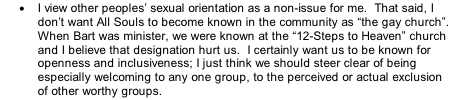
Here's a few additional quotes from All Souls members in the June 2005 report that provide us evidence of this homophobia and heterosexism (text from June 2005 report pasted in as graphics):





Folks, it's pretty disingenuous to say that we're not homophobic and we don't have a problem with gays, but we don't want to be known as the "gay church" in Shreveport.

To examine why this "gay church" concern may suggest that we still have some work to do, it's worth using a resource developed by psychologist Dorothy Riddle:
Riddle Homophobia Scale: Attitudes Toward Differences
In a clinical sense, homophobia is defined as an intense, irrational fear of same sex relationships that becomes overwhelming to the person. In common usage, homophobia is the fear of intimate relationships with persons of the same sex. Below are listed four negative homophobic levels, and four positive levels of attitudes towards lesbian and gay relationships / people. They were developed by Dr. Dorothy Riddle, a psychologist from Tucson, Arizona.

Homophobic Levels of Attitude
Repulsion: Homosexuality is seen as a "crime against nature." Gays/lesbians are sick, crazy, immoral, sinful, wicked, etc. Anything is justified to change them: prison, hospitalization, behavior therapy, electroshock therapy, etc.

Pity: Heterosexual chauvinism. Heterosexuality is more mature and certainly to be preferred. Any possibility of "becoming straight" should be reinforced, and those who seem to be born "that way" should be pitied, "the poor dears."

Tolerance: Homosexuality is just a phase of adolescent development that many people go through and most people "grow out of." Thus, lesbians/gays are less mature than "straights" and should be treated with the protectiveness and indulgence one uses with a child. Lesbians/gays should not be given positions of authority because they are still working through their adolescent behavior.

Acceptance: Still implies there is something to accept. Characterized by such statements as "You're not lesbian to me, you're a person!" or "What you do in bed is your own business." or "That's fine with me as long as you don't flaunt it!"

Positive Levels of Attitudes
Support: The basic ACLU position. Work to safeguard the rights of lesbians and gays. People at this level may be uncomfortable themselves, but they are aware of the homophobic climate and the irrational unfairness.

Admiration: Acknowledges that being lesbian/gay in our society takes strength. People at this level are willing to truly examine their homophobic attitudes, values, and behaviors.

Appreciation: Value the diversity of people and see lesbians/gays as a valid part of that diversity. These people are willing to combat homophobia in themselves and others.

Nurturance: Assumes that gay/lesbian people are indispensable in our society. They view lesbians/gays with genuine affection and delight, and are willing to be allies and advocates.
Source - http://www.d.umn.edu/~hrallis/professional/presentations/ally_training/riddle_scale.htm
My experience with the Welcoming Congregation process suggests that our congregation is stuck at the "tolerance" and "acceptance" positions on the Riddle Scale.

As a congregation, we are a long way from "support" ... especially if we are unwilling to be personally "uncomfortable" (e.g. not willing to be known as the "gay church).

We still have some unresolved work to do on congregational homophobia and heterosexism at All Souls.

27 May 2006

Tim Berners-Lee and Net Neutrality

The Unitarian Universalist computer scientist Tim Berners-Lee has recently started a blog. His most recent post is on the "net neutrality" issue.

As Unitarian Universalists with a committment to affirm and promote the "free and responsible search for truth and meaning," the "net neutrality" issue is important to us.

Here's a brief quote from Tim's blog:
The Internet is increasingly becoming the dominant medium binding us. The neutral communications medium is essential to our society. It is the basis of a fair competitive market economy. It is the basis of democracy, by which a community should decide what to do. It is the basis of science, by which humankind should decide what is true.

Let us protect the neutrality of the net.
... and you can read the rest of it online here.